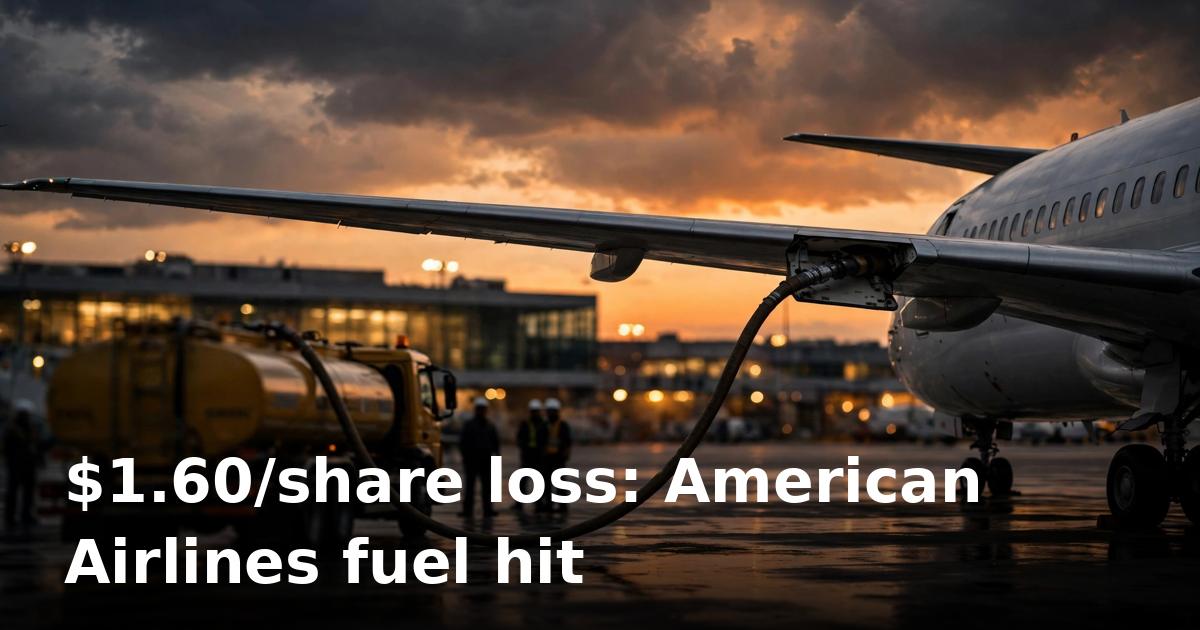

American Airlines on Thursday forecast a deeper full-year 2026 loss, becoming the fourth major U.S. carrier this month to cut its outlook as jet fuel costs climb faster than airlines can lift fares. The Fort Worth carrier now expects an adjusted loss of $1 to $1.60 a share for 2026. That scraps the July guidance range, which stretched from a 65-cent profit to a 65-cent loss. The new midpoint of minus $1.30 a share is a full $1.30 per share worse than the old breakeven midpoint. The culprit is fuel: American's third-quarter fuel bill reached $4.64 billion, up 67.5% — an extra $1.9 billion — from a year earlier. Jet fuel prices have surged since the Iran war began, and American, which carries no fuel hedges, has taken the hit straight to its bottom line.
The kicker is that the revenue side was as good as it gets. Third-quarter revenue hit a record $16.34 billion, up 19.3% from a year earlier and above the high end of the company's own guidance range.
But the quarter's arithmetic shows why the record top line could not save the bottom line. Of the roughly $2.64 billion in extra revenue American brought in versus last year's third quarter, fuel alone swallowed $1.9 billion — about 72 cents of every incremental revenue dollar. GAAP net loss widened to $269 million, or 41 cents a share, from $114 million, or 17 cents, a year ago. On an adjusted basis the loss was 28 cents a share, still narrower than the 35-cent loss analysts expected, and revenue beat the $16.22 billion consensus. Premium cabins were the engine: premium revenue jumped 22.9%, main-cabin revenue rose 19.5%, and total unit revenue climbed 14.5%. Chief executive Robert Isom said the airline delivered "record third-quarter revenue and the strongest year-over-year revenue growth in my career, with premium performance leading the way."
| American Airlines Q3 2026 | Result | Year-ago |
|---|---|---|
| Revenue | $16.34B, +19.3% YoY | $13.70B (computed) |
| Fuel bill | $4.64B, +67.5% YoY | $2.77B (computed) |
| GAAP net loss | $269M ($0.41/share) | $114M ($0.17/share) |
| Adjusted EPS | -$0.28 (consensus -$0.35) | — |
Why it matters
American is not an outlier — it is the latest domino. Delta Air Lines, United Airlines and Southwest Airlines all slashed their 2026 outlooks earlier this month, making American the fourth major U.S. carrier to surrender to fuel costs in October. The pattern is identical everywhere: fares are rising hard — U.S. airfares ran nearly 23% above last year in the seven months through September, according to Labor Department data — yet ticket-price growth still cannot keep pace with fuel. That is a direct read on the wider economy. Consumers are absorbing the sharpest fare increases in years, and the inflation impulse is not fading. With the September CPI print at a hot 3.7% year over year and the Fed in a tightening cycle after its 25bp hike on September 16, persistently rising transport costs are exactly the kind of pressure that keeps a rate move on the table for the October 27-28 meeting. Crude is not helping: WTI traded near $99 a barrel today, up 2.1% on the day in our market snapshot, as attacks on Saudi oil infrastructure keep risk premium in the barrel — the same energy squeeze we flagged in our USD/CAD oil-rally read and covered across our economy coverage.
What to watch
- For the final quarter, management pointed to an adjusted deficit of 50 cents to $1.10 per share, top-line expansion of up to 22.5% from a year earlier, and seat-mile capacity growth of 5.5% to 6.5%.
- Whether Delta chief Ed Bastian's warning plays out: airlines may need to curb flight growth next year to protect fares — "capacity discipline" for an industry running out of cost levers.
- Jet fuel and crude prices. American has no fuel hedges, so every dollar move in fuel flows almost straight to earnings.
- The October 27-28 FOMC meeting: persistent service-sector inflation, airfares included, backs the case for another hike with October odds near 49%.
MarketRadar take
The record-revenue-versus-widening-loss split tells the whole story. American's commercial strategy is working — unit revenue up 14.5%, premium up 22.9% — but an unhedged carrier in a near-$99-oil world is a fuel-price tracker with wings. The industry's answer, per Bastian, is capacity discipline: fewer seats, fuller planes, higher fares. That protects pricing power but keeps travelers paying up — and feeds a fresh leg of service-sector inflation the Fed will notice. Bearish for airline margins near term; watch whether Q4 revenue can grow the projected 22.5% without the fuel line eating it all again.