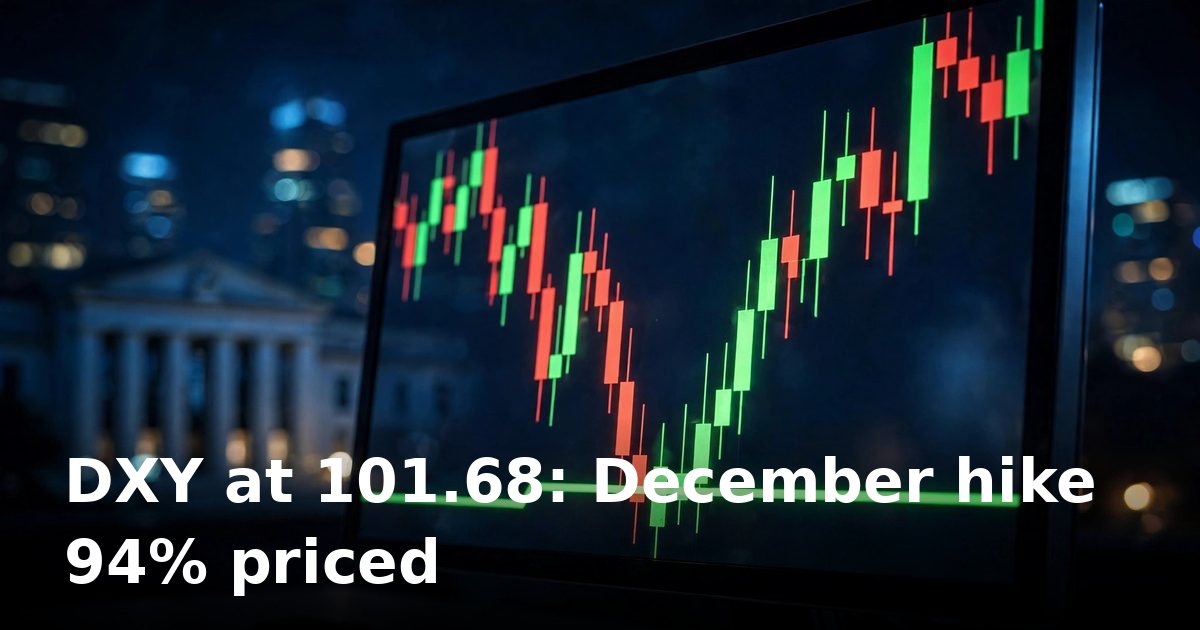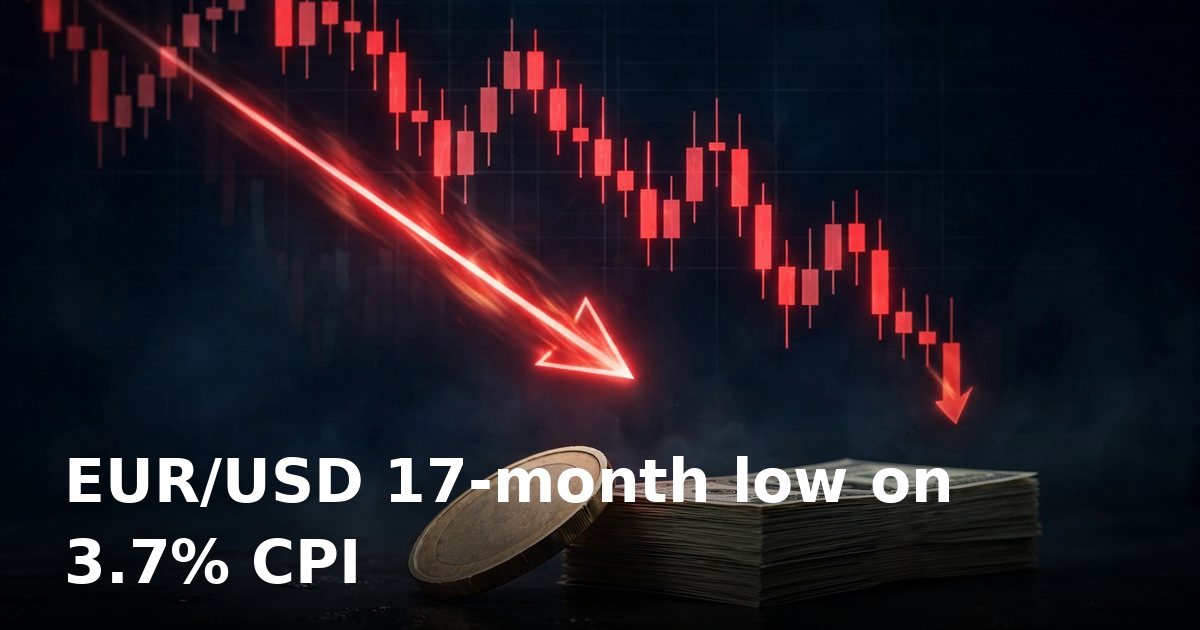

EUR/USD finally broke.
The 1.1150 floor had survived four separate tests since October 5. It snapped within five minutes of Wednesday's US inflation release. The pair slid to just above 1.1100, the weakest euro print since May 2025, before bouncing back to the old floor at the New York close. About half the drop was retraced. The range break on the daily chart is what traders will remember.
The trigger was unambiguous. September's headline US inflation ran at 3.7% year-on-year, up from 3.4% in August and above the 3.6% consensus. The number that counted for the Fed was core prices: up 0.3% month-on-month against a 0.2% forecast. That pushed the annual core rate to 2.6% from 2.4%. Gasoline alone jumped 9.1% in the month and accounted for more than half of the headline rise.
Futures markets repriced fast. Hike expectations for October 28 went from near one-in-five odds before the data to close to a coin flip afterward. Barchart put the October probability at 44%, up from 22% the day before. The US 10-year yield spiked above 5.32% before easing back toward 5.17%, and the dollar index climbed to around 102.70, its highest since April 2025.
Why it matters
This is no longer a dollar story built on positioning. It is built on arithmetic.
The Fed funds band sits at 3.75%-4.00% against the ECB's 2.50% deposit rate — a 125-150 basis-point gap that already favors the dollar. An October Fed hike would widen that to 175 points unless the ECB matches it the next day, at its own October 29 decision. Both central banks meet within 24 hours of each other, so the rate gap could move twice in two days. Setups like that produce sharp FX moves, not drift.
| Item | Level |
|---|---|
| EUR/USD post-CPI low | ~1.1100 (weakest since May 2025) |
| Broken floor (4 tests since Oct 5) | 1.1150, now resistance |
| Core CPI September m/m | 0.3% (forecast 0.2%) |
| Headline CPI September y/y | 3.7% (consensus 3.6%) |
| Oct 28 Fed hike odds | ~20% to ~50% post-release |
| Fed funds band | 3.75%-4.00% |
| ECB deposit rate | 2.50% |
| US 10-year yield post-release | >5.32%, eased to ~5.17% |
There is a European side to this as well. Belgium's central bank chief suggested on Wednesday that the ECB likely needs one more rate increase. President Lagarde pushed back. There is still no sign, she said, of energy costs feeding through into wages and broader prices. An ECB split, sitting right under a currency at its weakest since May 2025.
What to watch
- Thursday: US producer prices (core forecast to slow to 4.4% y/y from 4.6%), retail sales, and the NY/Philly Fed factory surveys; euro area August industrial production.
- Friday: euro area final September inflation (core forecast steady at 2.5% y/y) — a hot print strengthens the case heading into the ECB's rate decision on the 29th; Fed Chair Warsh speaks in the last window before the pre-meeting blackout.
- The price levels: 1.1150 is now overhead resistance, 1.1100 is the new floor, and the 50-day moving average sits just above 1.1400 with the 200-day above 1.1500 — both well above current prices.
MarketRadar take
Bearish for EUR/USD. Every driver pointed the same way on Wednesday: hotter core inflation, a repriced hike curve, a 10-year yield back above 5.32%, and a dollar index at an 18-month high.
The pair sits below both its 50- and 200-day moving averages. It just took out a floor that absorbed four tests in nine days. Technicians read that as a range break with downside room toward the psychological 1.1000 line.
The caveat is positioning. Momentum readings had been pinned in oversold territory for roughly four weeks, and half of Wednesday's drop was already retraced by the close. A soft US PPI on Thursday or a hawkish ECB signal before October 29 could slow the move. But the macro sequence into month-end still favors the dollar.