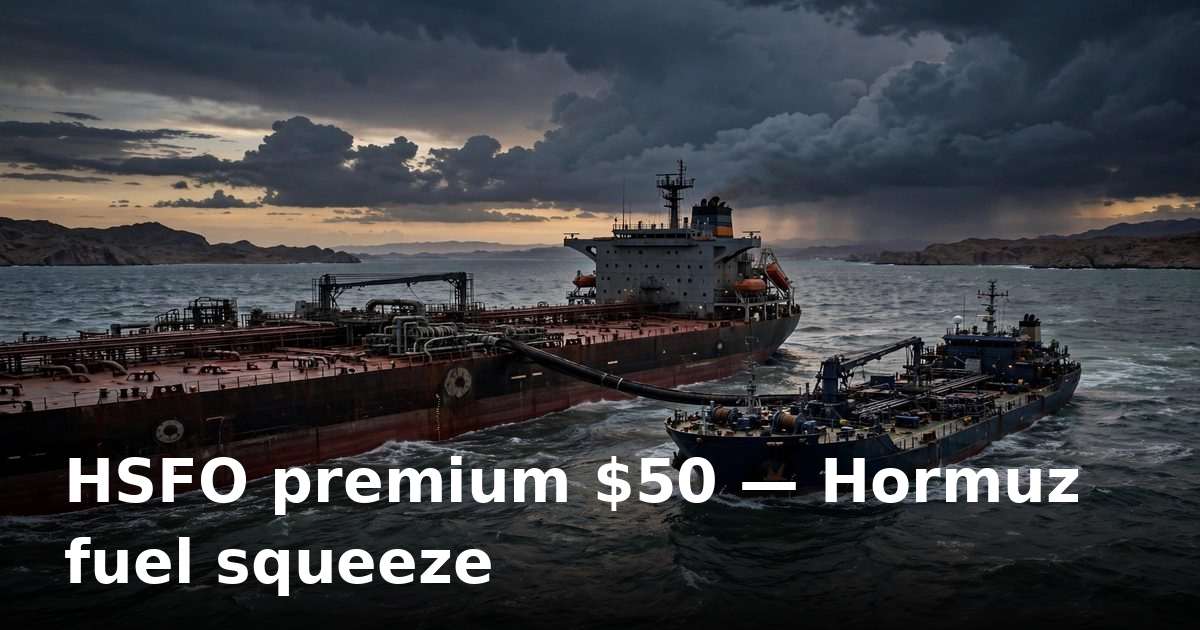

LSEG data cited by Reuters shows 380-cst high-sulphur fuel oil changing hands near $50 a ton over spot this week — compared with just $5.10 back on February 27. That is roughly a tenfold jump in the price shipowners pay above benchmark for the dirty bunker fuel that powers most of the world's fleet. The squeeze has barely loosened even as crude exports through the Strait of Hormuz pick up again: more crude is moving, but it is not turning into more fuel oil.
The numbers came from Kieran Gallagher, Vitol's Asia head, at SIBCON — Singapore's bunker industry conference — this week. Bloomberg, covering the same remarks, put it plainly: accelerating crude exports through Hormuz "aren't translating into higher production of a dirty shipping fuel," and supplies are tightening with prices soaring.
Hostilities around the strait remain the core problem. Gallagher said flows of fuel oil through Hormuz, Iran's share included, are still running at least 800,000 tons a month below February levels. Kpler puts normal monthly exports through the strait at roughly 3.7 million tons across the January 2025–February 2026 window. The gap has narrowed from the 2-million-ton monthly loss seen in May, but Russian refinery attacks have since taken out roughly another million tons of monthly fuel-oil supply. Producers, Gallagher added, now swallow higher freight bills and risk premiums to keep cargoes moving out of Hormuz, because oil revenue matters so much to national budgets.
Demand is not helping. Refiners in North Asia have begun running fuel oil through their upgrading units rather than crude, sourcing upwards of a million tons of HSFO, with November liftings, after Red Sea disruptions forced Saudi crude exporters to reroute. Underlying bunker demand has held up. Gallagher said the fix is to swap fuel oil back out of the feedstock slate in favor of crude.
Gallagher pointed to rising Chinese exports and to Nigeria's Dangote refinery, which loads two or three Suezmax-sized cargoes each month. Vitol — which handles about 15 million tons a year of bunker fuel — has been adapting: it has offered ship refueling at Pakistan's Gwadar Port since July, an alternative to the UAE's Fujairah just outside the strait, and plans to start LNG deliveries in Singapore in the coming weeks, with its first LNG bunker vessel arriving in November and two further vessels next year. The pivot tracks the data.
LNG bunker sales in Singapore reached 487,100 tons over January–September 2026, more than 21% above the prior-year period.
Why it matters
Fuel oil is the transmission belt between crude disruptions and shipping costs. Crude may be flowing out of the Gulf again, yet refineries are not converting it into the fuel ships burn. When HSFO premiums run at $50 a ton instead of $5, every vessel refueling in Asia pays a surcharge that ends up in freight rates and, eventually, the price of goods.
MarketRadar take
| Metric | Value |
|---|---|
| 380-cst HSFO spot premium, this week | ~$50/ton |
| HSFO spot premium, Feb 27 | $5.10/ton |
| Premium multiple since Feb | ~9.8x |
| Hormuz HSFO shortfall vs Feb | ≥800,000 mt/month (~22% of the 3.7M baseline) |
| Russian refinery fuel-oil loss | ~1M mt/month |
| North Asian refiner extra Nov pull | >1M tons |
| Combined monthly tightening pressure | ~2.8M tons |
| WTI, MarketRadar snapshot | $95.90 (-2.11%) |
| Brent (Thursday close) | ~$103.97 — ~$8 transatlantic spread |
Our math: $50 divided by $5.10 is a 9.8x multiple — ten times the premium from February. The 800,000-ton Hormuz shortfall is roughly 22% of pre-crisis monthly exports through the strait. Add the 1-million-ton Russian loss and the 1-million-plus tons North Asian refiners want for November, and the market faces about 2.8 million tons a month of tightening pressure against a normal Hormuz flow of 3.7 million. The crude-to-fuel-oil conversion chain is broken, not the crude itself — which is why "more Hormuz crude" has not eased the squeeze.
Brent sits near $104 while WTI prints $95.90 in our snapshot — a roughly $8 transatlantic spread, far wider than the usual couple of dollars, which signals a seaborne crude market under strain while landlocked US crude trades on domestic fundamentals. Freight tells the same story: chartering a VLCC from the US Gulf to China hit $80 million this week, about $40 a barrel — nearly half the price of the oil it carries.