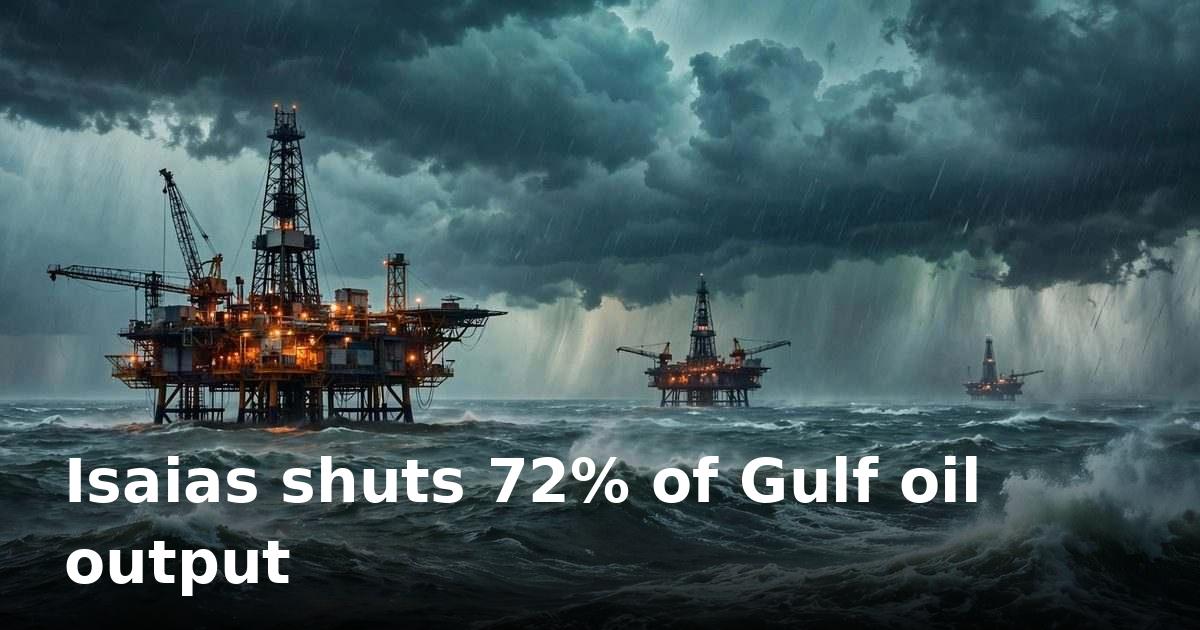

Hurricane Isaias came ashore near Destin, Florida late Friday as a Category 2 storm with sustained winds of 105 miles an hour, and the energy industry saw it coming. Hours before landfall, American producers had already pulled roughly 1.5 million barrels a day of offshore crude offline — about 72% of the entire Gulf of Mexico's output. Natural gas lost around 1.3 billion cubic feet a day, or 59%, with workers pulled from 129 production platforms and eight drilling rigs, federal offshore data show.
The federal waters of the Gulf normally pump close to 2 million barrels a day, about 15% of total US crude production. Earth Science Associates reckons the storm could take roughly 7.2 million barrels out of the market before output is fully back to normal, down from 9 million only because the track jogged east.
At Friday's WTI print near $91.80, that is about $661 million of crude temporarily sidelined — one storm, one night, and a nine-figure hole in the weekly supply balance.
| Measure | Figure | Reported by |
|---|---|---|
| Oil output shut in | ~1.5m bpd (72% of Gulf) | Reuters / Marine Minerals Administration |
| Gas output shut in | 1.3 bcf/d (59% of Gulf) | Reuters / Marine Minerals Administration |
| Platforms evacuated | 129 of 371 staffed | Marine Minerals Administration |
| Total volume disrupted | ~7.2m barrels | Earth Science Associates |
| Value at WTI $91.80 | ~$661m (MarketRadar calc) | Snapshot, 2026-10-09 |
| Refining capacity in path | ~500k bpd | Energy Aspects |
| VLCC hire, US Gulf to Asia | ~$79m ($39.50/bbl) | Baltic Exchange via Bloomberg |
| Homes and businesses blacked out | ~830,000 | PowerOutage tracker |
Timing is the real story here, more than the wind. Isaias is switching off Gulf barrels at the exact moment the Iran war is snarling the Middle East trade lanes that would normally backfill them, and the tanker fleet is already stretched.
Bloomberg reports that hiring a very large crude carrier from the US to Asia now runs about $79 million — close to $39.50 a barrel — which puts an ironic ceiling on the damage: those missing barrels would have struggled to find buyers abroad anyway.
Refineries got lucky. A late eastward jog kept Isaias away from the big refining clusters, including Chevron's Pascagoula plant in Mississippi, even though Energy Aspects estimated half a million barrels a day of refining capacity lay in the projected path. For residents the worst was the blackout: about 830,000 homes and businesses in Florida, Alabama and Georgia sat in the dark by Saturday, 430,000 of them in Florida alone.
Why it matters
Energy traders rarely get two supply shocks stacked on each other like this. The hurricane alone is routine — offshore platforms are built to shut down and restart, and most of the missing barrels should return within days. But the Iran war has already lifted Brent into a war premium near $104 and tied up the tankers that would normally carry relief cargoes, so there is no easy relief valve. When freight itself is the bottleneck, a domestic outage bites harder than the headline number suggests, and this weekend is the live test of that logic.
What to watch
- Restart speed: crews inspect platforms before re-staffing; damage to pipelines or shore facilities turns a days-long outage into a weeks-long one.
- The VLCC market: if $79 million freight holds, US export economics stay pinned no matter how fast Gulf output returns.
- Gas flows: 59% of Gulf gas offline is a real hole in LNG feedgas once terminals restart.
- Sunday and Monday headlines — the first credible "all clear" reprices crude.
MarketRadar take
Crude carries a clear near-term bullish tilt while nearly three-quarters of Gulf output sits idle into the weekly open. That tilt has a short shelf life: once platforms pass inspection, the 7.2-million-barrel hole fills itself. The risk that matters is not wind damage but the restart calendar — a one-day delay re-staffing Mars and Ursa moves Monday's price more than anything the storm did to the water. With refineries intact and the blackouts a demand-side blip, this is a supply story, full stop.