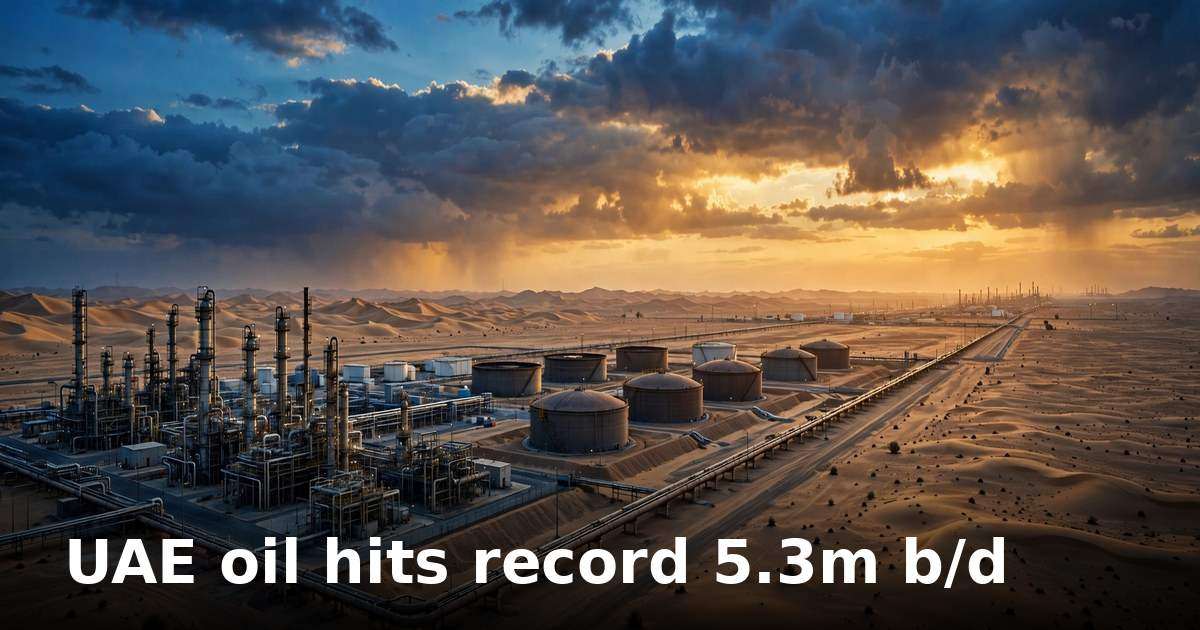

The United Arab Emirates pumped oil at record levels in September, the International Energy Agency said on Wednesday, a surge that underlines how far the country has pushed its output free of OPEC caps. The IEA put total oil output, condensates included, at 5.3 million barrels daily — 400,000 above the August figure, which had itself been the previous record. That number comes from the agency's October Oil Market Report, released Wednesday.
Crude alone topped 4.4 million barrels a day, the agency said, leaving Abu Dhabi close to its maximum production capacity. That means the producer adding the most barrels to the market right now is also the one with the least room left to add more.
The wider Gulf recovery is real but shaky. Flows from regional producers climbed past three-quarters of their pre-war level during September, with Saudi Arabia doing the heaviest lifting, and global supply up 2.5 million barrels a day on the month to 102.3 million. OPEC+ output rose 2.1 million barrels a day, and the IEA credited the UAE with most of the gains outside the group. Yet the agency cautioned that a new round of Iranian strikes against tankers in the Strait of Hormuz — plus escalating Houthi hostilities — has clouded how much of that rebound survives into October.
Why it matters
This is the clearest proof yet of the UAE's bet on quitting OPEC in May. Freed from quotas that had frustrated Abu Dhabi for years, the country has become the engine of the Gulf supply rebound, shuttling cargoes through Hormuz on its own tanker fleet and transferring them onto other vessels past the chokepoint. Brent still closed up 0.6% at $106.37 on Wednesday, and WTI gained 1.2% to $95.30 — prices that held firm despite a record production month. That tension is the story: the barrels are flowing, but demand destruction is flowing faster, with the IEA now forecasting global demand to contract 2.6 million barrels a day on average in 2026, a quarter of it diesel.
Here is the arithmetic traders should notice. Output rose 400,000 barrels daily — while above-ground stocks were drawn down at a pace never seen before, exceeding 270,000 barrels a day, so that observable stocks sank to the lowest level on record. Roughly two-thirds of the "production gain" never accumulated anywhere; it went straight into tanks that were already emptying.
The inventory picture:
| Figure | September | Source |
|---|---|---|
| UAE total oil (incl. condensates) | 5.3m b/d (+0.4m vs Aug) | IEA (new record) |
| UAE crude output | above 4.4m b/d | IEA, near max capacity |
| UAE stock drawdown | 270k+ b/d | IEA, fastest ever recorded, lowest stocks on record |
| Gulf flows recovered | >75% of pre-war | IEA, Saudi Arabia led |
Record diesel margins — nearly $95 a barrel in September — show where the physical market hurts most, which is why IEA members are coordinating a 100-million-barrel release of oil and diesel from strategic reserves.
What to watch
- IEA board meeting, Oct 14-15: details of the G7's 100-million-barrel oil and diesel reserve release are due — a direct price-dampener for diesel cracks and flat price alike.
- Hormuz tanker traffic: September's recovery assumed flows hold; renewed Iranian attacks on tankers put that at risk in real time.
- October refinery runs: the IEA expects a seasonal low of 81.3 million barrels a day before a rebound to 84.6 million by year-end — crude demand rises even as the war eats product supply.
- The capacity question: with UAE crude near its ceiling, the next supply upside has to come from Saudi Arabia or from demand destruction doing the work itself.
MarketRadar take
The record headline flatters the bull case for supply more than the market should. The UAE is now producing at roughly full capacity — its output is a ceiling, not a cushion — and it paid for September's record by emptying its own tanks. Near-term, the combination of all-time-low inventories, renewed Hormuz attacks, and a 100-million-barrel SPR release about to hit the market keeps price action two-sided around $103-$107; we have been tracking that exact range while geopolitical forecasts point to a wider conflict premium. The IEA's longer view is clearer: demand shrinking 2.6 million barrels a day this year and supply surging 7.7 million next year is a recipe for surplus — the bullish window is this winter, not next spring.