
Applied Digital (NASDAQ: APLD) just posted the kind of quarter AI-infrastructure bulls dream about — and the stock still fell. Quarterly revenue hit $341.9 million, more than quadrupling the prior year and landing at nearly three times the ~$116 million consensus estimate. The adjusted per-share loss narrowed to a single cent against expectations of a 30-cent loss. Yet APLD slipped about 1.1% on Thursday to $23.55, a price that sits closer to its $20.55 52-week low than its $49.65 high.
The paper backlog is enormous. Five dollars of signed future revenue per dollar of market cap.
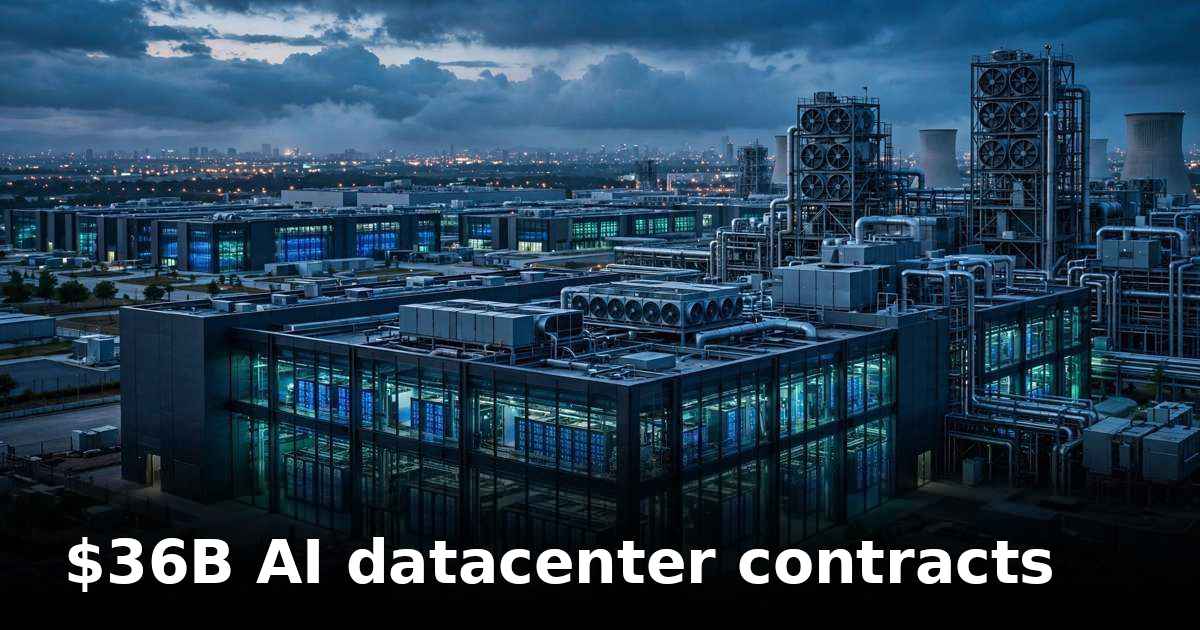
Lease contracts on Applied Digital's books now total roughly $36 billion in base-term payments — as much as $86 billion if every tenant extension gets exercised. Across five US campuses, about 1.41 gigawatts of critical IT load is leased out: CoreWeave occupies Polaris Forge 1 in North Dakota, another blue-chip cloud operator takes Polaris Forge 2, and a single top-tier hyperscaler holds the three remaining sites. At a market value near $6.9 billion, the equity market is pricing in a fraction of the signed business.
Why it matters
The spread between what's signed and what's built is the entire argument. Motley Fool's take on the print was pointed: the company books tens of billions in AI datacenter contracts, while the physical sites behind them are still largely under construction. Only about 250 megawatts of the 1.41 gigawatts under lease is live and billing today — barely 18%. Everything else is execution risk: construction timelines, financing cost, and dependence on a handful of tenants, with $6.4 billion of debt sitting against $3.7 billion of cash and restricted cash. The bottom-line GAAP loss deepened to around $184 million for the quarter.
Then there's the tape itself. Thursday was risk-off across the board: the S&P 500 finished at 7,770, down 0.41%, the Nasdaq lost 0.65% to close at 27,361, and the Dow dropped 0.39% to 50,978. WTI crude surged 4.9% to $92.60 after reports that Iran is intensifying tanker attacks, feeding the same energy-inflation anxiety already running through hawkish Fed minutes. AI buildout earnings — this print and TSMC's record Q3 on AI chip demand — are the counter-narrative: the physical layer of the tech rally is real, and the market is now sorting, name by name, which builders actually get paid.
What to watch
- Polaris Forge 1 delivery cadence: 250 MW runs today against a 400 MW contracted footprint. Each building that goes live turns paper backlog into billed rent.
- The financing picture: $6.4B in borrowings vs $3.7B cash, with four more campuses still under construction and interest expense already running at $77M a quarter.
- Tenant concentration: CoreWeave anchors one campus; two hyperscalers hold the rest. A delay at any single site hits the P&L directly.
- Finland: rights to roughly a gigawatt of future power, the company's first non-US foothold. Watch for customer commitments before it becomes real capex.
- The short trade: bears hold about a fifth of the tradable float, so a clean delivery beat could squeeze — while any slip gives them a fresh catalyst.
| Campus | Tenant | Build status |
|---|---|---|
| Polaris Forge 1 (ND) | CoreWeave | 250 MW live of 400 MW |
| Polaris Forge 2 (ND) | Blue-chip hyperscaler | Under construction |
| Polaris Forge 3 (ND) | Top-tier hyperscaler | Under construction |
| Delta Forge 1 (LA) | Top-tier hyperscaler | Under construction |
| Delta Forge 2 (AL) | Top-tier hyperscaler | Under construction |
MarketRadar take
The ratio is what makes this one worth tracking from an index perspective: roughly five dollars of signed revenue for every dollar of market capitalization, contracted with hyperscalers — and the stock fell anyway. That says the AI trade has grown up. In 2026, investors pay for megawatts that are switched on, not megawatts under lease. If Applied Digital keeps delivering buildings the way it delivered Polaris Forge 1's Building 2 (150 MW in two phases, live capacity now 250 MW), the backlog-to-cash story becomes hard to argue with, and the heavy short position turns from verdict into fuel. The next building to go live is the number that matters — not the press release.