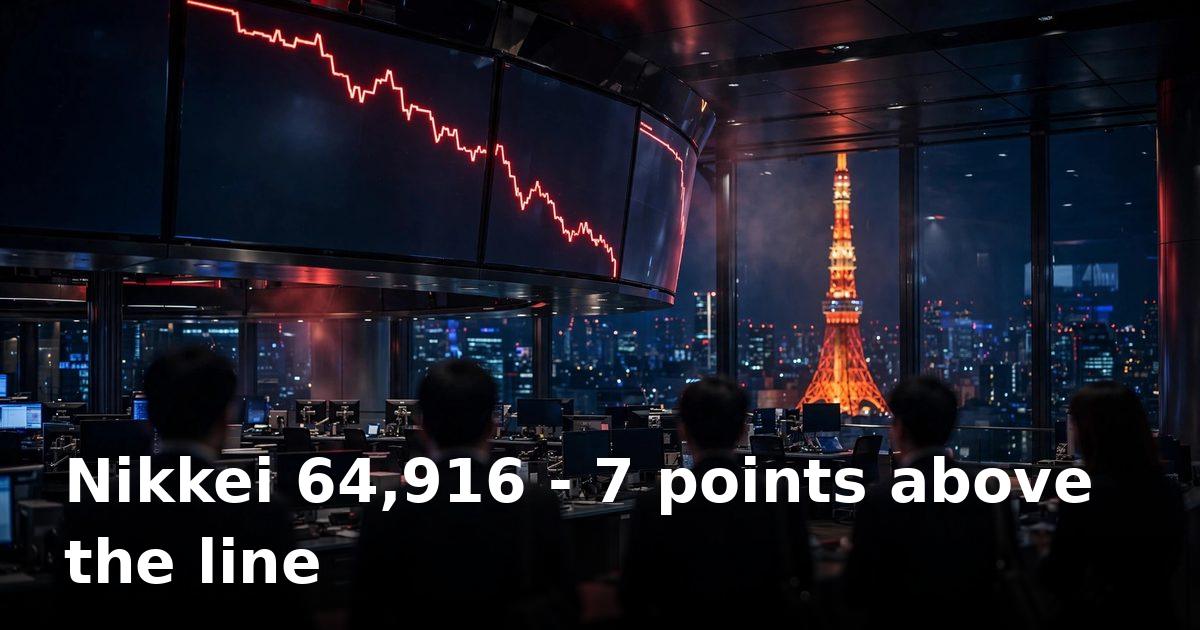

Japan's Nikkei 225 gave back part of Friday's rebound on Monday, sliding 407.59 points, or 0.62%, to close at 64,916.70. Financial shares, technology stocks and automakers led the retreat, with chip equipment names under renewed pressure after another rough session for US semiconductors on Friday. The index opened at 64,819 — down 505 points from Friday's close — then sank as low as 63,831.78, a 1,493-point intraday washout, before bargain hunters lifted it back into the close. The session high was 65,067.80, so the index still finished in the lower half of its daily range.
The number that matters: 64,910. Monday's close left just 6.7 points of daylight above that plateau.
Context makes the wobble look more serious. Friday had halted six straight down days — a slide of more than 6,240 points, about 9.1% — with a 898.34-point, 1.39% rebound to 65,324.29. Running the math on the streak implies it began near the 70,870 zone, which means Monday's close sits roughly 8.4% below where the slide started. In other words, one strong Friday repaired about a seventh of the damage, and Monday's sellers immediately tested whether even that repair would hold.
Why it matters
Three cross-currents are squeezing Tokyo at once, and none of them is local. The first is the US rate repricing: the NAHB/Wells Fargo builder sentiment index fell three points to 29 in October, its lowest since June 2012, as 30-year mortgage rates averaged 7.40% — the latest sign that the Fed's September hike and the bond market's response are biting the real economy. With the October 27-28 FOMC meeting a week away, traders were still pricing roughly 17% odds of another hike this month and near 90% by December as of Friday's close, and the 10-year Treasury hovered just above 5.1% on Monday morning. The second is oil: WTI for November delivery settled near $103.70, up more than 2% on the day, while Brent held around $109.55, as Houthi attacks on Saudi energy infrastructure and a tanker mine explosion in the Strait of Hormuz kept supply fears elevated. The third is the AI funding question that triggered Thursday's 6.5% Kospi plunge and the Nikkei's own 3.1% slide: the Philadelphia Semiconductor Index has now fallen eight straight sessions, down 16% cumulatively, and credit stress at names like CoreWeave is spreading from equities into debt. Tokyo's chip complex — Tokyo Electron, Advantest, SoftBank — sits directly in that blast radius. The Nikkei's earlier slide below 69,400 showed how fast the rate-and-oil combination travels across the Pacific.
| Index | Monday close | Change |
|---|---|---|
| Nikkei 225 | 64,916.70 | -0.62% |
| TOPIX | 4,067.48 | +0.04% |
| KOSPI | 5,768.01 | +1.76% |
| Shanghai Composite | 3,730.92 | +0.39% |
| TAIEX | 46,822.08 | -0.61% |
| S&P/ASX 200 | 8,845.70 | +0.44% |
Hong Kong was closed for the day after the Chung Yeung Festival. The scoreboard shows Tokyo as the regional laggard — the only major market besides Taiwan to finish red.
What to watch
- The 64,910 plateau. A daily close below it opens the path toward the 63,831.78 intraday low, with Thursday's 64,425.95 closing base the next reference underneath.
- US equities diverged. The S&P 500 and Nasdaq both closed in positive territory while the Dow finished marginally lower, and computer hardware stocks bounced 2% off Friday's two-month low, per RTTNews. Whether chip buyers show up for a second day decides if Tokyo gets a tailwind at Tuesday's open.
- The October 27-28 FOMC meeting. Another hot inflation signal or hawkish speaker could re-ignite the rate repricing that started this slide.
- Crude and the Strait of Hormuz. WTI above $103 and Brent near $109.55 keep input-cost pressure on Japanese industrials and automakers; analytics firm Kpler puts Hormuz crude flows at 8.5 million barrels a day last week, down from more than 20 million the week before.
- Chip earnings and AI capex commentary this week. Any wobble in spending plans lands hardest on Tokyo Electron, Advantest and the broader semiconductor supply chain.
MarketRadar take
Monday was a failed follow-through day, and those matter more than the 0.62% headline decline suggests. Friday's bounce is already half-erased in spirit: the index couldn't hold its opening bid, needed a 1.7% intraday rescue to stay above 64,910, and closed in the lower half of its range. With chip funding worries unresolved, oil above $103 and the FOMC a week out, the near-term bias stays cautious — though the dip-buying impulse is clearly alive, and any wash toward the 63,830 zone should find demand before it finds air.
| Level | Price | Note |
|---|---|---|
| Resistance | 65,324.29 | Friday's close |
| Resistance | 65,067.80 | Monday session high |
| Pivot | 64,910 | Plateau — held by 6.7 points |
| Support | 64,425.95 | Thursday close, streak-end base |
| Support | 63,831.78 | Monday intraday low |