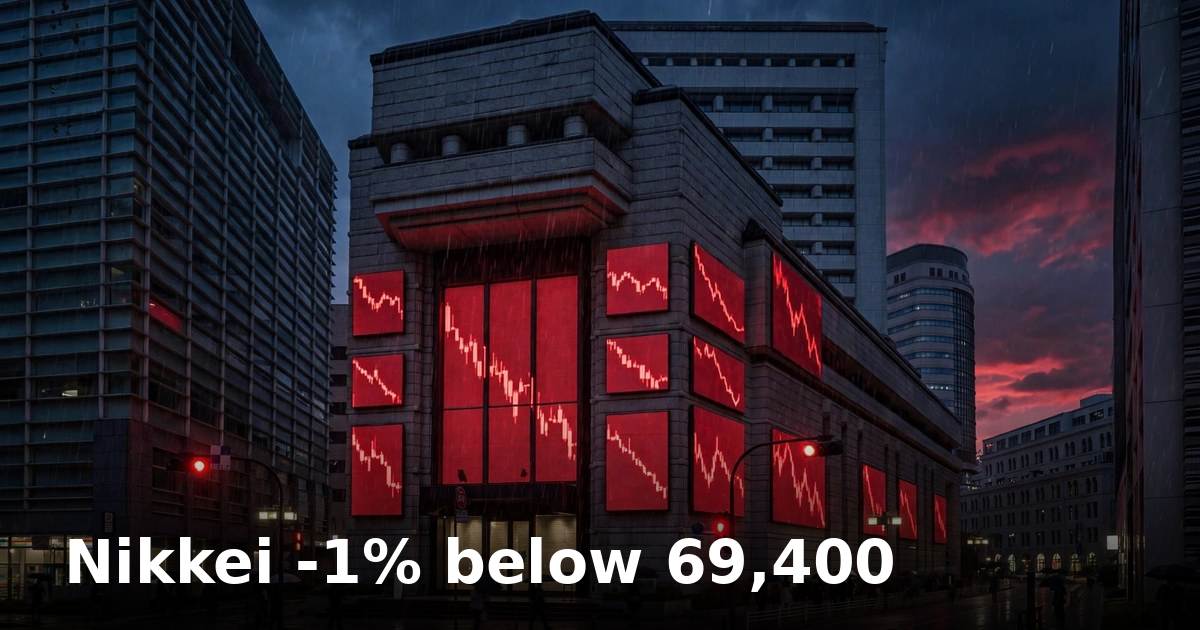

Tokyo opened Thursday under pressure and never found its footing. The Nikkei 225 dropped about 1% in early trade to 69,339.80, sliding under the 69,400 mark, a day after it closed down 648.27 points — 0.92% — at 70,035.71. The broader Topix fell harder, losing 1.42%. Three forces did the damage at once: a tech-led retreat on Wall Street overnight, minutes from the Federal Reserve's September meeting that read more hawkish than the market wanted, and Brent crude pushing back above $101 a barrel on rising US-Iran tensions.
The two-day slide has stripped roughly 1,350 points — about 1.9% — from the index. Wednesday's break of 70,000 turned a former floor into the first resistance bulls must retake.
The Fed minutes were the real weight on the session. Released Wednesday, they showed a majority of officials leaning toward one more rate increase before the year is out, even as the committee keeps each meeting officially open-minded. Traders now price just a 19% chance of a move at the October meeting but 80% odds of an increase in December. Goldman Sachs told clients it expects that second hike in December. The bank added that it sees a strong chance the Fed then decides further tightening is unnecessary. That 80% December number is the market's way of saying September's hike was a beginning, not an end. On Thursday morning the 10-year Treasury yield sat at 5.298%, after touching 5.326% overnight — the highest in 24 years. A strong 10-year auction helped pull it off the peak, and the 2-year held at 4.78%. For Tokyo, the mix is toxic: higher-for-longer US rates strengthen the dollar, weaken the yen, and drain liquidity from risk assets all at once.
Oil supplied the second punch. Brent put on 0.9% to settle at $101.14 a barrel while US crude gained 0.8% to reach $89.02, and both benchmarks kept climbing in Asian hours — Brent was last up 1.52% at $101.73, WTI up 1.4% at $89.50. The bid is pure escalation risk: reports say the US military has been told to prepare for a possible strike on Iran, and fresh attacks on tankers transiting the Strait of Hormuz have traders pricing in genuine supply disruption. For Japan, an energy importer, $100 oil is a direct tax on growth — and worse, it feeds the same inflation that keeps the Fed hawkish. A loop with no easy exit.
| Market | Thursday move | Level |
|---|---|---|
| Nikkei 225 | -1.0% (early trade) | 69,339.80 |
| Topix | -1.42% | — |
| Kospi | -0.6% | — |
| S&P/ASX 200 | -0.51% | 8,682.90 |
| MSCI Asia-Pacific | -0.3% | — |
Why it matters
Thursday was a stress test of the whole 2026 playbook, and Asia failed it first — the mirror image of Wednesday's US pullback: yields up, oil up, equities down, with AI euphoria no longer enough to offset either. Overnight on Wall Street, the S&P 500 slipped 0.2%, the Nasdaq 100 matched it, and the Philadelphia Semiconductor Index lost 1.2% — the same chip weakness that bled into Tokyo's tech heavyweights the next morning.
Then there is the bond-market subplot, and it is getting crowded. The Wall Street Journal reports that SpaceX, Broadcom, and Oracle are all tapping debt markets to fund AI-chip purchases. Broadcom is lining up $50 billion of financing, while SpaceX plans $30 billion of investment-grade bonds together with $10 billion in bank loans, all earmarked for Nvidia hardware. Credit-default insurance on SpaceX has jumped to record highs. Nigel Green of deVere Group warned that a buildout once funded with cash is increasingly running on credit — and that changes the risk profile for everyone holding the paper. All of this corporate issuance lands just as sovereign bond markets strain under inflation fears and widening deficits. The morning's one bright number belonged to Samsung, which guided to a 783% jump in third-quarter operating profit — 107.4 trillion won, roughly $80.17 billion. Its shares still slipped 0.3%.
Currency markets told the rest of the story. The dollar index climbed to 102.22, close to an 18-month peak, while the euro sank to $1.1198 — near 17-month lows — as French fiscal worries spread to Italian and Greek debt. The yen sat at 157.90 per dollar, steady only because traders still fear intervention after July's operation. The Fed minutes added a remarkable footnote: America's share of that intervention was funded by the US Treasury, not the Fed itself. With USD/JPY hovering near 158, that threat is the only thing standing between the pair and a fresh push higher.
What to watch
- 10-year Treasury yield — 5.298% after a 24-year high of 5.326% overnight. Another leg up hits Tokyo's growth stocks first.
- December Fed pricing — 80% odds of a hike leave room for repricing if officials push back on the minutes' tone.
- US-Iran headlines and Hormuz shipping — Brent at $101.73 is one incident away from a bigger spike; oil's latest run already has the IMF warning about energy shocks.
- USD/JPY 157.90 — intervention chatter grows louder with every tick toward 160.
- Nikkei 69,000 — the next round number below Thursday's lows, roughly 0.5% under early-trade levels.
MarketRadar take
The tape has turned tactically defensive for Japanese equities. Two sessions have taken the Nikkei from above 70,000 to below 69,400, and the drivers — hawkish Fed repricing, $100-plus oil, and a wobbling AI-credit complex — are all still in play. The index sits about 0.5% above the 69,000 round number, which is now the line to hold; 70,035, Wednesday's close, is the resistance to beat. Near term, Tokyo trades as a function of the 10-year yield and the Hormuz headlines, not domestic fundamentals — until one of those two turns, rallies are for selling, not chasing.