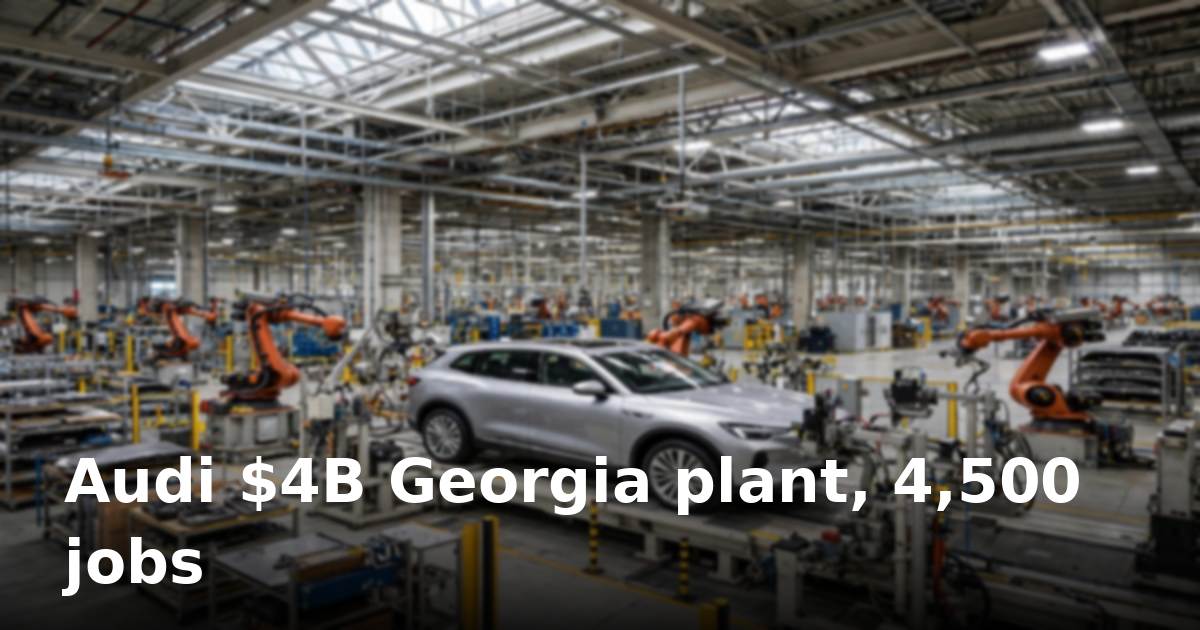

President Donald Trump announced on Saturday that Audi will build its first factory in the United States, in Georgia, with Audi chief executive Gernot Döllner joining him on stage at a rally in Perry to confirm the plan. The plant will sit at the Middle Georgia Megasite near Macon, and Audi's own release puts the investment at around $4 billion with approximately 4,500 jobs attached. Trump, announcing the project to the rally crowd, pegged the figure higher, at $4.2 billion, and described it as the largest single investment in the history of the American auto industry.
The two figures describe the same project: Audi's formal release says "around $4 billion," while the president's rally number rounds the commitment up to $4.2 billion. The jobs number is not in dispute — both Audi and Georgia put it at about 4,500 — and once running, the plant is designed for annual output of up to 200,000 high-end SUVs aimed at buyers in North America.
A move debated for at least two decades is now a construction schedule.
Reuters, reporting ahead of the announcement, said the Georgia plant is expected to assemble the Q7, Q8 and Q9 — the large SUVs at the top of Audi's range, and the models most exposed to import tariffs today, because every Audi sold in the United States is currently shipped in from Europe or Mexico. Construction is scheduled to begin in 2027, according to Audi's release, with production planned for the early 2030s, so the first Georgia-built Audi is still roughly five years away even though the announcement landed this weekend.
Why it matters
The tariff angle is the thread running through the whole announcement. Trump has pressed foreign automakers to build in the United States and has imposed heavy duties on imported cars and trucks, with a 25% levy on vehicles and parts cited in coverage of the announcement. For Audi, that turns a long-standing strategic gap into a live cost problem: it is the last German marque still building nothing on American soil, while BMW builds in South Carolina, Mercedes-Benz builds in Alabama, and its own corporate cousin Volkswagen builds the Atlas in Chattanooga, Tennessee. Local production does not just dodge the tariff line — it shortens supply chains, puts the factory next to the customer, and, in Audi's own words, reduces exposure to trade and currency risks. Friday's market snapshot put EUR/USD at 1.1204, a reminder that a German company selling dollar-priced cars from euro-cost factories carries currency risk on every vehicle; a Georgia plant prices much of that chain in dollars.
How this developed
This was not a sudden decision dressed up as one. The Wall Street Journal reported that building Audi vehicles in the United States has been under consideration for at least two decades, and the logic kept strengthening as rivals localized production in the American South. BMW's South Carolina plant and Mercedes-Benz's Alabama plant both grew from single-model operations into export hubs. Volkswagen's Chattanooga plant, by contrast, builds only one model, the Atlas, leaving Audi — the group's premium brand — as the conspicuous absentee from American manufacturing.
Reuters reported on Friday, citing a government official, that Trump would announce the Georgia plant on Saturday, with 200,000 SUVs a year and the Q7, Q8 and Q9 in the frame. On Saturday the president made the announcement at the Perry rally, Döllner appeared on stage to confirm the company's commitment, and Audi followed with its formal release setting out the investment, jobs and timeline. Georgia governor Brian Kemp, who announced the project jointly with Döllner, said the state had bought and improved the Middle Georgia Megasite precisely to land a manufacturer of this calibre.
The numbers
The headline figures hold up across all three corroborating sources, and the arithmetic underneath them shows what kind of project this is — capital-heavy, slow to build, and sized for a market Audi says it has barely tapped.
| Project figure | Number |
|---|---|
| Investment, Audi's release | Around $4 billion |
| Investment, Trump's rally figure | $4.2 billion |
| Planned jobs | About 4,500 |
| Annual capacity at full output | Up to 200,000 vehicles |
| Construction starts | 2027 |
| Production starts | Early 2030s |
| Site | Middle Georgia Megasite, near Macon |
| Models reported | Q7, Q8, Q9 (Reuters) |
Dividing the investment by the jobs gives roughly $889,000 of capital spending per planned job at Audi's $4 billion figure, or about $933,000 per job at the $4.2 billion rally figure — the signature of a highly automated premium plant rather than a labour-intensive assembly line. Per unit of annual capacity, the spend works out to $20,000 at $4 billion and $21,000 at $4.2 billion. At full output, 200,000 vehicles across 4,500 workers comes to about 44 vehicles per worker per year. The timeline matters as much as the money: roughly five years from this weekend's announcement to the first production in the early 2030s, with construction itself not starting until 2027, so the jobs and the output arrive on very different schedules.
What to watch
- Construction milestones in 2027: grading, supplier announcements and hiring timelines will show whether the schedule holds.
- Tariff policy: any change to the 25% levy on imported vehicles and parts changes the urgency — but not the logic — of local production.
- The South Carolina element Reuters reported ahead of the announcement, involving 25,000 vehicles, which was not part of the Georgia confirmation and remains to be clarified.
- Supplier and training announcements around the Middle Georgia Megasite, which Audi says should create opportunities beyond the plant itself.
- Whether additional models join the Q7, Q8 and Q9 before production starts.
MarketRadar take
Read this as a structural story, not a quarterly one. Nothing in the announcement changes Audi's near-term earnings — the first Georgia-built vehicle is years away — but it closes the largest gap in Volkswagen group's American footprint and converts a tariff exposure into a domestic cost base. For Georgia, the prize is a 4,500-job anchor at a purpose-built megasite, with supplier work around it. For the wider auto sector, the signal is that the tariff era is pushing even the most import-dependent premium brands to localize. The numbers to track from here are not Audi's share price this week but the 2027 construction milestones and any tariff-policy shifts in between.