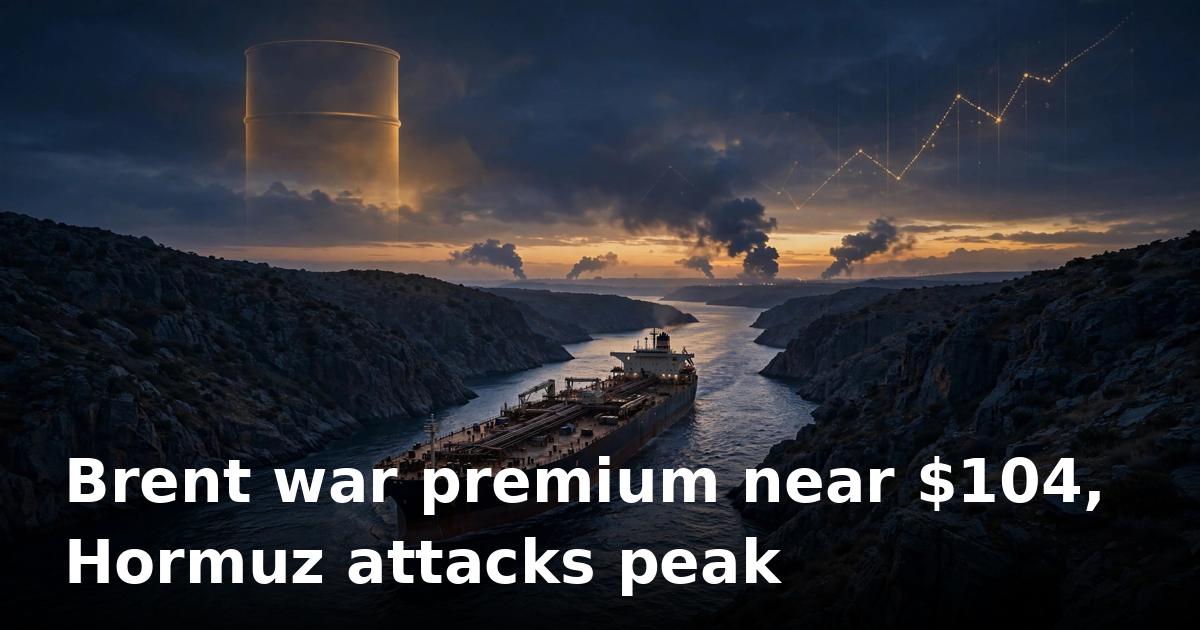

Brent crude futures held just under $104 a barrel on Friday, refusing to give back the war premium that has built up through the Strait of Hormuz shipping crisis. The benchmark traded at $103.76 in early Friday trade, down only 52 cents, or 0.5%, after US President Donald Trump said Washington would not attack Iran before next month's midterm elections and described talks with Tehran as "productive," according to a Reuters report on October 10. The shallow dip said more about the market's mood than the headline did: one comment about diplomacy knocked half a percent off, and then buyers stepped straight back in.
Twelve dollars and fifty cents. That is the market's current price tag on the fear that a tanker will not make it through the strait.
The premium is where the real story lives. Against West Texas Intermediate at roughly $91.28, the Brent-WTI spread sat near $12.50 on Friday — a gap that has almost nothing to do with barrels being produced and almost everything to do with barrels being moved. Brent is the waterborne benchmark, the price of oil that must cross oceans and choke points to reach a refinery. WTI is the landlocked one, cushioned by record US production and no exposure to the Gulf. When the spread blows out past $12, the market is not pricing crude. It is pricing risk on ships.
That risk is measurable, and this week it hit a new extreme. Reuters reported on October 8 that attacks on tankers sailing through the Strait of Hormuz reached their highest weekly count since the US-Israeli conflict with Iran began in February. The waterway carried roughly 20% of the world's oil and fuel before the war, and the attack surge has come precisely as more crude is being pushed through it at higher cost and higher risk to crews. The International Energy Agency agreed to accelerate the release of strategic oil stocks and prioritize diesel supplies under a plan launched in March — but as Reuters noted, those releases cannot replace lost production capacity, and the market has treated them as a cushion rather than a cure.
Why it matters
For an economy like India's, a $104 Brent with a $12 war premium is not an abstraction on a trading screen; it is a line item that will show up in the import bill, the trade deficit, and eventually the inflation print. The timing could hardly be worse. India imported a 2026 high of 5.26 million barrels a day of crude in September, driven by a surge of Gulf supplies moving through alternative arrangements — large tankers crossing Hormuz with transponders switched off, then transferring cargo ship-to-ship in UAE and Omani waters, according to reports from ET Energy World and Times Now citing Kpler tanker data. Run the arithmetic: 5.26 million barrels a day at $103.76 works out to roughly $546 million of crude a day, or about $16.4 billion across a month. West Asia's share of that intake has jumped to 39.5%, around 2.10 million barrels a day, with Iraq reclaiming the number-two supplier spot behind Russia for the first time since February.
Two background forces are tightening the same vise. The dollar is sitting near recent highs — the MarketRadar snapshot had USD/JPY at 158.25 and EUR/USD at 1.1206 on Friday morning — which inflates the local-currency cost of every barrel bought in dollars, and the rupee closed at 96.31 per dollar on October 1, a two-month low. Then there is the Graham Bill, US legislation that would empower the American president to impose tariffs of up to 100% on India and other buyers of Russian oil — exactly the supplier India leaned on hardest while Gulf flows were disrupted. If that threat hardens, Indian refiners face a forced rotation back toward the Gulf barrels that carry the Hormuz premium. The freight market has already priced the same anxiety: supertanker rates are above $1 million a day, and yesterday's MarketRadar report showed VLCC charters from the US Gulf to Asia hitting $80 million — about $40 of freight for every barrel in the cargo.
What to watch
- The Trump-Iran talks: any sign of substance beyond "productive" would take an immediate bite out of the premium; a breakdown would do the reverse.
- The weekly Hormuz tanker-attack count, now at its wartime peak — one more bad week and supertanker rates have no ceiling.
- Flows through the Saudi overland line that bypasses the strait — the kingdom's energy minister says shipments have recovered to 5.8 million barrels a day after September's drone damage.
- IEA stock-release pacing, and whether member governments put more diesel into the accelerated program ahead of winter.
- India's October crude-intake data: whether the September record of 5.26 mb/d holds and how much of it the rupee's weakness is offsetting.
MarketRadar take
Strip out the risk and this market should be trading much lower: US production is at a record, Gulf exports have partly recovered, strategic reserves are being released, and the EIA's own September outlook has Brent averaging near $90 in the second half of the year. The fact that Brent is parked $12 above that level, with a $12.50 spread over WTI, tells you the premium is entirely about the logistics of moving oil, not the economics of producing it. That makes the direction unusually legible: the premium compresses when tankers cross Hormuz safely for consecutive weeks and widens on every attack. Near-term we read this as neutral-to-bullish for Brent, not because demand is strong — consumer data in the US is weakening — but because the supply-risk floor has not moved. A genuine diplomatic breakthrough on Iran changes the picture fast; until then, the freight market stays expensive and the premium stays wide.
| Supplier | September intake | Note |
|---|---|---|
| Total crude imports | 5.26 mb/d | 2026 high (Kpler tanker estimates) |
| West Asia (all suppliers) | 2.10 mb/d, 39.5% share | Up from 26% in August |
| Russia | 1.74 mb/d | Largest supplier, lowest since April |
| Iraq | 0.525 mb/d | Second-largest, first time since Feb |
| Saudi Arabia | 0.517 mb/d | Strong recovery on Hormuz workarounds |
| UAE | 0.438 mb/d | Lower month-on-month |
| Kuwait | 0.335 mb/d | Highest in a year |