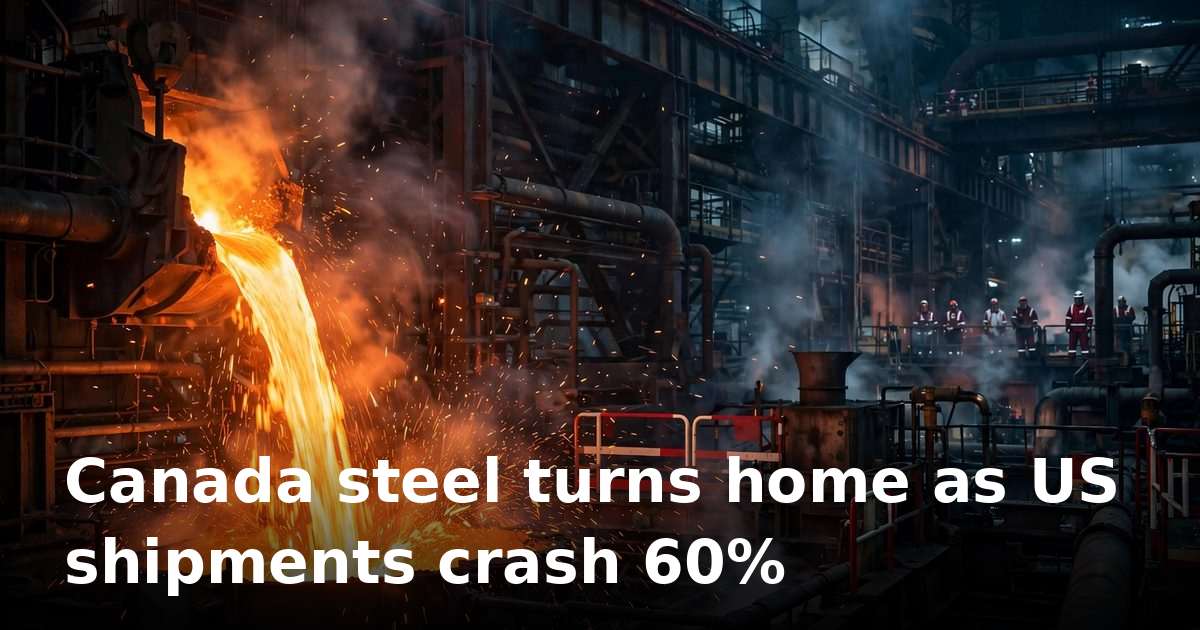

Canada's steel industry is learning to sell to itself. Shipments to the United States — once about 90% of the country's steel exports — collapsed by 60% in 2025, after Washington doubled the steel levy to 50% that June, up from 25%. Yet the home-made slice of Canadian steel consumption reached 51% last year, up from 41% a year earlier. That is the United Steelworkers' calculation, built on World Steel Data and Canadian import records. The import portion fell in mirror image, from 59% to 49%.
That 10-point swing is the whole story: an industry that lived on American buyers is relearning to live on Canadian ones.
The orders are coming from mines, energy projects and AI data centers. A 1.2-gigawatt data center is under construction in Saskatchewan. Prime Minister Mark Carney has said a new Pacific Coast oil pipeline would add further steel demand. Canadian steel demand grew roughly 2.7% in 2025, and the OECD expects another 0.9% in 2026. Steel counts for less than 1% of Canadian GDP. But it has become the proving ground for Carney's push to make the economy less dependent on the United States, with Ottawa's backing behind it at every step.
Why it matters
For investors, this is the clearest live test of a big question: can an economy absorb a tariff shock by redirecting demand inward, instead of retaliating its way out? Ottawa is backing the bet. In May it rolled out working-capital loans totaling roughly C$1 billion — near $700 million — for steel, aluminum and copper producers. It extended the tariff rate quota that caps foreign steel entering the country. And it is steering infrastructure spending toward Canadian-made steel through its Buy Canadian policy. Similar tariff-driven supply reshuffles have already shown up in the US trade balance data (US trade deficit hits $105.6B as August imports surge). The mining capex cycle behind the demand pickup is the same one rattling copper markets (Escondida copper strike set for Wednesday).
The pain has not vanished. Algoma, the country's largest producer, cut 1,000 jobs in Ontario in December. That is nearly all of the sector's layoffs since tariffs landed. Cleveland-Cliffs, which bought Stelco in 2024, faces a threat of legal action from Ottawa over planned cuts at its Hamilton plant. Cliffs reports quarterly results on October 19. That should give a sharper read on how much of the Canadian operation survives.
What to watch
- Cleveland-Cliffs' quarterly results on October 19: guidance on the Stelco/Hamilton operations and the threatened job cuts
- Whether Ottawa tightens the tariff rate quota on imported steel further, as the United Steelworkers is demanding
- The Tenaris C$306 million expansion at Sault Ste. Marie, Ontario — a bet that Canadian oil and gas customers can replace US orders
- Infrastructure and defence orders at Algoma, whose chief executive says the turn toward Canadian buyers and a plate-focused product mix is paying off
- Any shift in Washington's 50% Section 232 steel tariff posture in the bilateral talks
MarketRadar take
The arithmetic is working, so far. A 10-point gain in domestic share plus 2.7% demand growth is absorbing the loss of a market that took 90% of exports. This is a sector under 1% of GDP, where policy can move the needle. But the recovery is propped up: C$1 billion in loans, import quotas, and government-directed purchasing are doing a lot of the lifting. The real test is whether the mining, energy and data-center pipeline outlasts the subsidies. Until the October 19 Cliffs print, the direction for Canadian producers reads cautiously up — with the caveat that the crutch could matter more than the cure.