
Caterpillar (NYSE: CAT) ended the week above $800 a share, roughly 43% higher than where it started 2026. On October 1 the industrial heavyweight traded near $822, though that remains well short of the $1,073.46 peak it set on June 30 — the top of its 52-week range. In a new write-up, Motley Fool analyst James Halley lays out the case that the shares could reach $1,000 by 2028 — and the numbers behind the argument are hard to dismiss.
The second quarter was a record on nearly every line. Sales came in at $20.5 billion, up 24% from $16.6 billion a year earlier. Operating margin widened to 20.9% from 17.3%, while per-share earnings climbed 68% to $7.77. On a net basis, margins improved from 13.2% to 17.5% as profit grew from $2.2 billion to $3.6 billion. Operating cash flow printed $6.14 billion, against $5.72 billion in the same quarter last year. The dividend also went up 8%, marking 32 straight years of payout increases.
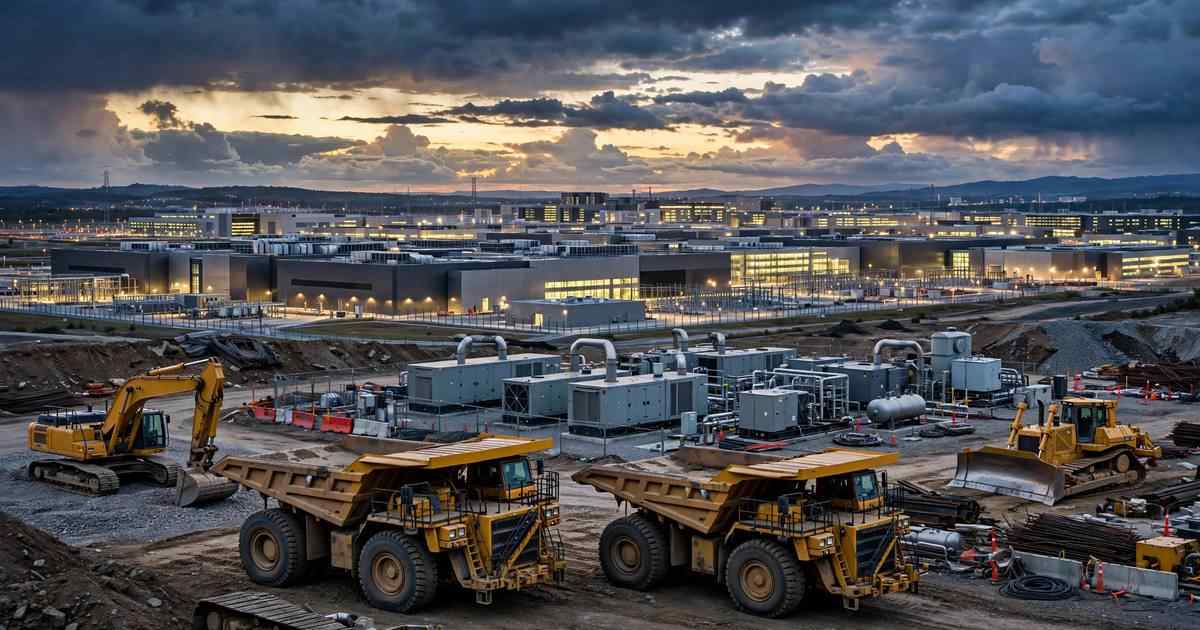
The surprise in the story is what is driving the growth. The AI build-out has created a power bottleneck: hyperscalers cannot get grid connections fast enough for their data centers, and in many regions large customers face multiyear queues for interconnection. That gap is being filled by Caterpillar's energy and transportation unit, whose reciprocating industrial engines plus its Solar Turbines line now serve AI sites as primary or standby power. Against the 2024 baseline, capacity for large reciprocating engines is being tripled.
Why it matters
Caterpillar is a classic cyclical — construction and mining equipment ordered heavily in booms and shelved in busts. What the quarter suggests is a structural shift: a backlog above $70 billion — a company record — with power equipment demand from AI data centers and multi-gigawatt, multi-year contracts behind it, giving the company revenue visibility it has never had before. Management's goal: $30 billion of annualized services revenue by 2030, versus $24 billion today. High-margin services matter because a generator running around the clock can demand up to 40 times the lifetime parts and servicing of a standby diesel unit. That is the argument behind the re-rating — CAT now changes hands at roughly 35 times earnings, far above its five-year average.
That premium is the whole debate. Simply Wall St points out the tension: after a 70% run over twelve months, CAT sits near $811 while cautious valuation models put fair value underneath that quote. The bull case is that the AI power backlog makes earnings durable; the bear case is that 35x earnings is a price at which any pause in the data center rush hurts. Quarterly revenue is up 54% over five years; in the five years before that, growth was under 25%. That acceleration supports the higher multiple — but only while it lasts. The Micron record quarter showed the same AI capital-spending wave flowing through the semiconductor chain.
What to watch
- Power generation sales and backlog: whether the $70 billion-plus order book keeps growing in the next quarterly report.
- Reciprocating engine capacity: the tripling program against the 2024 baseline — delivery timing and customer signings.
- Services revenue progress toward the $30 billion-by-2030 goal.
- Mining capex: copper, lithium and rare-earth demand driving fleet refreshes, where CAT's autonomous haulage gives it an edge.
- The broader industrial tape: CAT is a Dow component, and the S&P 500 ended the week near record highs, so index flow matters for the multiple.
MarketRadar take
The fundamentals support the bullish momentum: a $70 billion backlog with multi-year AI power contracts, margins expanding on both the operating and net lines, and a services business that smooths the traditional construction cycle. CAT has effectively added a second growth engine to a cyclical one, and the market's higher multiple reflects that change. The counterweight is the math of 35x earnings — at that price, the stock is paying for the AI power rush to run for several more years. With the weekend outlook flagging data-heavy weeks ahead, CAT holders should watch the order book, not the headline EPS, from here.