
MarketRadar read: neutral
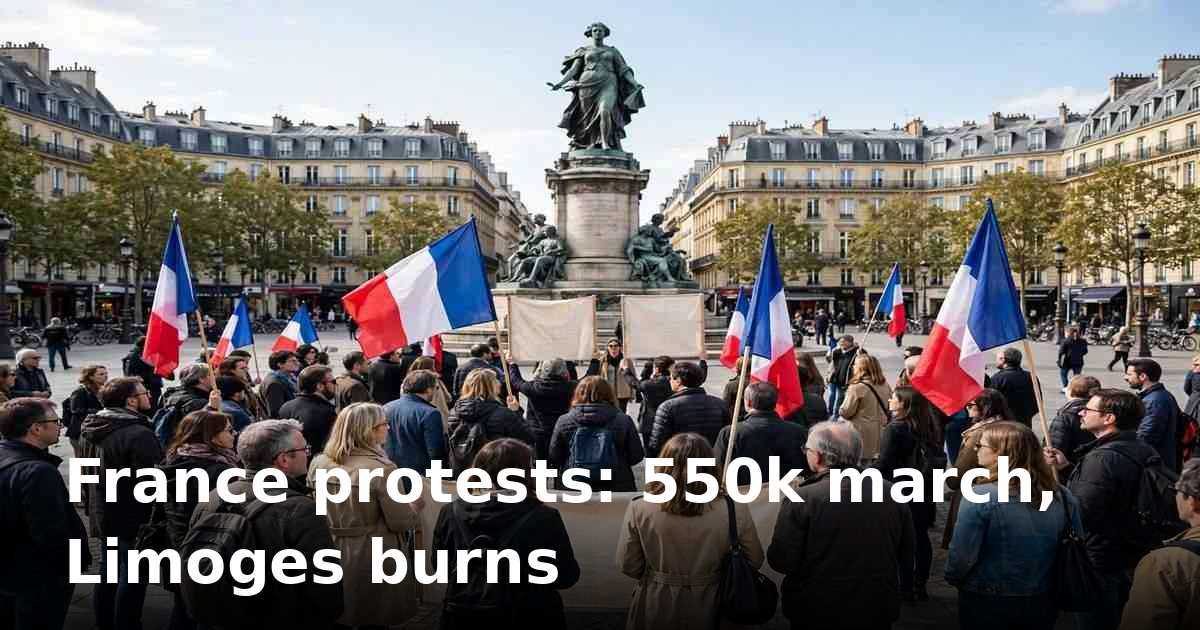
Hundreds of thousands of people took to the streets across France on Saturday, October 17, in a nationwide day of protest against rising living costs, run-down schools and cuts to public services. By nightfall the day had turned into some of the worst riots France has seen in decades: Limoges' town hall burned to the ground, luxury shops were looted in Paris, Marseille and Lyon, and more than 1,200 people were arrested.
The Interior Ministry put the nationwide turnout at about 550,000 people across scores of cities. The CGT, the country's biggest trade union, told Reuters the real figure was closer to 800,000. Either way, the crowds were larger than at the peak of the yellow-vest movement — a striking measure of how fast public anger has grown.
A day that spiraled: Paris, Limoges, Marseille, Lyon
Most marches began peacefully around midday. In Paris, a march of about 110,000 near Place de la République was gradually taken over by masked rioters in black. Police fired tear gas as demonstrators threw fireworks and paving stones and attacked a bank. "We're taking the Bastille!" one demonstrator shouted, according to Reuters.
On Boulevard Magenta, dozens of shops were looted — a Lacoste store ransacked, banks vandalized, a lorry burned — while more than 300 protesters tried to march up the Champs-Élysées before tear gas blocked them. Paris mayor Emmanuel Grégoire said the capital's streets had been left "devastated."
The most shocking images came from Limoges, in central France. Masked demonstrators torched the city hall — a building opened in 1883 that had survived two world wars. The roof caved in, crushing the lower floors, and close to two-thirds of the building's front wall was destroyed. Prefect Maurice Barate told AFP the loss of the 143-year-old building was a "catastrophe for heritage." More than 15 people were taken into custody and prosecutors opened a criminal investigation.
Elsewhere: in Marseille, black-clad protesters smashed through the town hall doors using street security barriers, got inside briefly, and spray-painted an anarchist "A" on a wall before police removed them. In Lyon, demonstrators set the city's tourist office ablaze. An Apple store in Lille was stripped bare. Shops were looted in Marseille, Nice, Bordeaux and Lille.
By the numbers, the day ended with a stark tally — though the official and union figures do not fully agree:
| Measure | Interior Ministry / government | CGT / organizers |
|---|---|---|
| Nationwide turnout | 550,000 (Minister Laurent Nuñez) | 800,000 |
| Paris turnout | 110,000 | not disclosed |
| Arrests | ~400 (Nuñez, early tally) → 1,200 (PM Lecornu, evening) | not disclosed |
| Police injured | 60, two hospitalized (Nuñez) → 150+ (Lecornu) | not disclosed |
Prime Minister Sébastien Lecornu pointed the finger at "ultra-left" radicals and criminal gangs for the violence, saying the government would not be "intimidated." Writing on X, he said people wanted to use the unrest as a "warm-up" before next year's presidential election. Interior Minister Laurent Nuñez called the looters "opportunistic delinquents" and said the state had no plans to declare a state of emergency. President Emmanuel Macron vowed the attackers would be prosecuted and punished, declaring the nation would stand together against the "sowers of chaos."
Police tactics are already under scrutiny: the police watchdog is investigating at least two dozen allegations of police violence, and the UNSA police union warned that officers were being pushed to breaking point. In Saint-Étienne, a young man lost a hand to a stun grenade — a second such incident in weeks, after a 15-year-old was similarly injured in Lens earlier in October.
How a school protest became a national uprising — the background
Saturday's explosion did not come from nowhere. The protests began last month at high schools in Paris's working-class northern suburbs, where anger over teacher shortages and crumbling buildings boiled over — then widened into a broader movement over inequality and living standards, with calls to revive the gilets jaunes (yellow vests) of 2018 drawing far larger crowds.
The CGT, one of France's biggest unions, backed the protests, demanding higher wages and pensions, lower prices and protected public services. On the ground, the anger is raw. "We are fighting because the cost of living is too harsh," said Lola, a 19-year-old protester in Paris, pointing to high fuel prices and to pupils she said were being attacked for demanding more teachers.
The economic pressure is real and measurable. An October poll of 2,000 residents found roughly 45% fretting over climbing prices and inflation. Gasoline, energy and food prices have spiked in recent months. And France's own public finances are under strain: the government's efforts to cut public debt have not reassured investors, pushing French government borrowing costs to their highest levels in more than two decades — a backdrop that leaves Paris with little fiscal room to buy calm with spending.
Macron is entering the final stretch of his presidency with a divided and gridlocked parliament. The CGT has already called a nationwide strike day for November 5, which markets will watch closely.
A European wave: Brussels, Lisbon, Milan, Tirana
France was not alone on Saturday. Reuters reported smaller cost-of-living protests across Europe:
| City | What happened |
|---|---|
| Brussels | Several hundred mostly young people marched against rising education costs; some clashed with police |
| Lisbon | Tens of thousands marched over housing and living costs — Portuguese housing prices have doubled since 2017 |
| Milan | A march degenerated into disorder; police cleared the cathedral square with tear gas |
| Bologna | Police used water cannon, seven arrests (per ANSA) |
| Tirana, Albania | Fifth day of student protests; police fired what appeared to be rubber bullets; protesters demand PM Edi Rama's resignation |
Saturday's unrest was not confined to France's borders, suggesting a shared economic root: years of elevated prices have steadily eroded household budgets across Europe.
MarketRadar analysis: what markets should watch
For investors, the immediate read-through is fiscal, not monetary. France's 10-year borrowing costs are already at a two-decade high; a government facing mass street pressure, a looming November 5 strike call and a presidential election next year has fewer credible options to tighten the budget further. The risk premium on French sovereign debt — and by extension European bonds — bears watching if the unrest drags into the autumn.
Two scenarios are now worth tracking. In the contained scenario, the 1,200 arrests deter a repeat, the government announces targeted relief, and the November 5 strike fizzles. In the escalation scenario, the CGT's strike call draws a second mass mobilization and political-risk keeps a discount on French assets through the winter. Watch: weekly turnout figures, any emergency fiscal announcements, and French 10-year yield spreads against German bunds.
One caution from the numbers: turnout and arrest figures come from sources with clear incentives — the Interior Ministry counts low, the CGT counts high — so the truth likely sits between 550,000 and 800,000.
France's cost-of-living crisis has moved from kitchen tables to city halls — and with a presidential election next year, Saturday may be remembered as the day the campaign truly began.