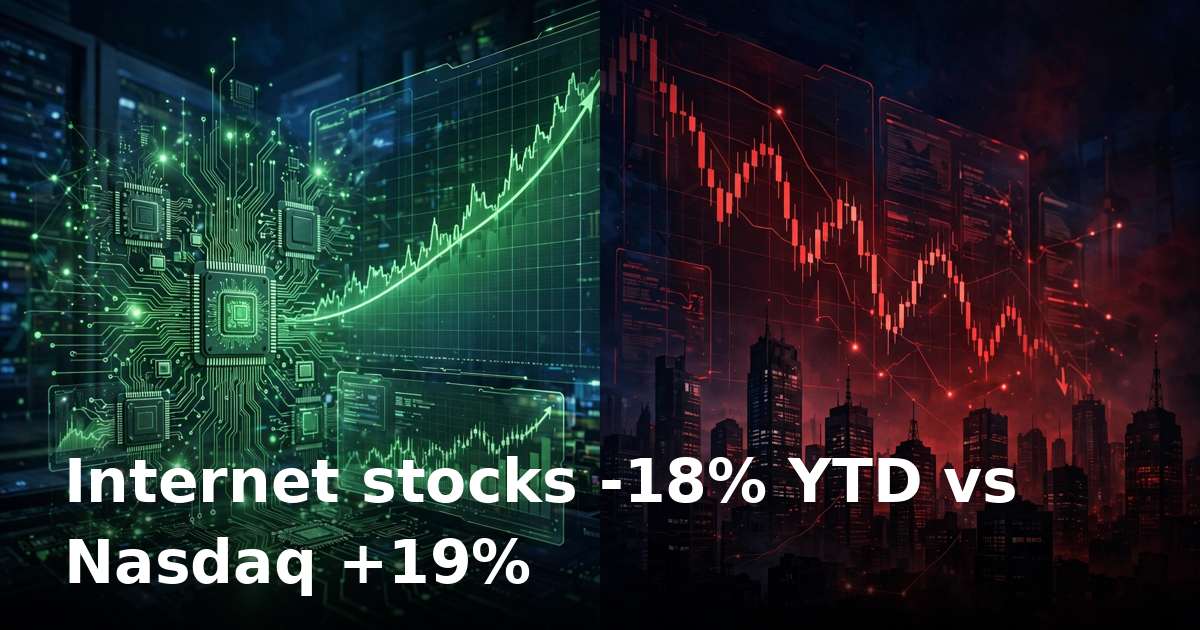

The Nasdaq Composite is up 19% this year and closed Friday at 27,366. The S&P 500 is up 14%, and both indexes set fresh record closes earlier in the week.
Now the part the headlines skip. Nineteen large-cap internet stocks in Evercore ISI's coverage universe have fallen an average of 18% this year. That 37-percentage-point gap between the basket and the Nasdaq is one of the widest index-versus-sector splits of the current bull run, and it is the subject of a new Evercore research note arguing the selloff has gone too far. Senior managing director Mark Mahaney expects upward revisions to hyperscaler revenue and operating income over the next three to twelve months, with free cash flow inflections acting as the catalyst to correct what he sees as a market mispricing.
Mahaney traces the split to six pressures he labels bear-market factors. Stretched valuations carried over from 2025 after a three-year bull run in internet names. AI disruption fears around terminal value, hitting travel and marketplace platforms including Booking, Expedia, Shopify and Uber. Rising capex intensity at the major hyperscalers, with spending as a share of revenue expected to climb further in fiscal 2027 and possibly 2028 — S&P Global projects 2027 capital spending of $357 billion at Alphabet, $319 billion at Amazon and $164 billion at Meta, with negative free cash flow at all three. Higher energy costs from the regional conflict in the Middle East weighing on consumer demand, with Brent holding a war premium near $104. A coming wave of mega-cap internet IPOs absorbing investor capital. And what the note calls "Muse risk" — autonomous AI agents becoming the primary consumer interface, threatening incumbents' control over customer relationships, ad monetization and transaction take rates.
Independent data backs the divergence theme. Financial Express reported on October 6 that 33 of the Nasdaq-100's constituents are down year-to-date even with the index at records, and only 6% of the index's stocks have hit new highs. Its mega-cap table shows Micron up 270.31% and AMD up 197.91% year-to-date against Netflix down 27.70% and Tesla down 15.33% — a spread of nearly 300 percentage points between the best and worst large caps. Thursday's session underlined how fragile the leadership is: Barron's noted the Nasdaq sank 1.3% in its worst single-day performance since mid-August after reports of lighter OpenAI revenue figures, before Friday's 0.64% rebound.
Why it matters
A market this narrow changes what "the Nasdaq is up" actually means for anyone not holding the AI chip complex. Index-level gains are a poor proxy for portfolio health when most constituents lag. One side of the capex argument — consensus pessimism or Evercore's optimism — is wrong by tens of billions of dollars, and the next few earnings prints will decide which.
What to watch
- Q4 earnings at Amazon, Alphabet and Meta: hyperscaler capex guidance and free cash flow trajectories will test the "mispriced cash flow" thesis directly.
- The December 8-9 FOMC meeting, where hike odds are running near 68-70%: another hike would compress the multiples of the already-beaten internet names further.
- The mega-cap IPO pipeline Mahaney flagged — a supply shock that could keep capital flowing out of listed internet stocks.
- Whether the OpenAI revenue question from Thursday grows into a broader AI-valuation rethink during earnings season.
MarketRadar take
The data supports Evercore's core observation: this is a concentration story, not an internet story. With the Nasdaq-100 carried by a handful of chip names and 33 constituents underwater, the beaten-down internet basket is priced for a capex disaster that may not fully materialize if revenue revisions land. That makes the risk-reward on large-cap internet names look better than the headline index suggests — but a December Fed hike remains the obvious threat to any multiple re-rating, so the optimism stays conditional on earnings confirming the cash-flow inflection.