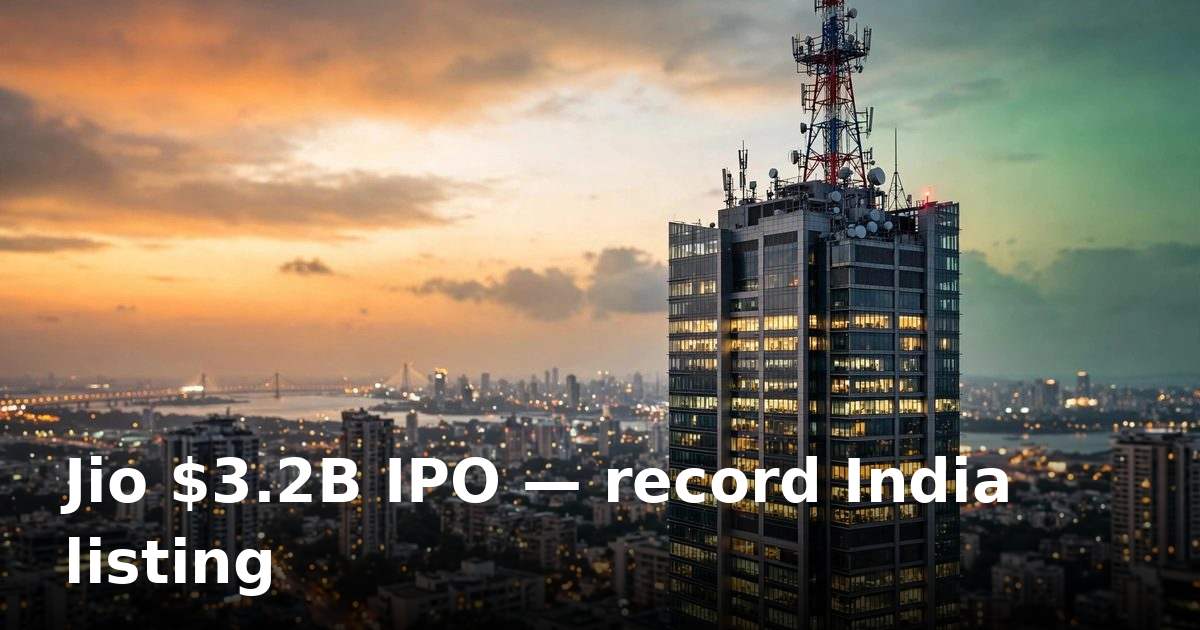

Reliance Industries' telecom arm Jio Platforms is raising up to $3.2 billion. Reuters, Bloomberg and CNBC each call it India's biggest IPO on record. Shares are offered between ₹1,065 and ₹1,119 apiece, per Reuters' reading of the updated prospectus. At the top of that range, Jio's equity value is about $108.3 billion. Subscription runs October 21 through 23. Anchor investors get their window on October 19. Trading is due to start October 28. Up to ₹275 billion — roughly $2.9 billion — repays borrowings at the telecom unit, Reuters reported. CNBC adds that Ambani is also funding gigawatt-scale green AI infrastructure from the raise. Fronting the listing is Akash Ambani, 34. He runs Jio Platforms as managing director and is the chairman's son, Livemint reported.
Why it matters
The valuation math is the real story here. At $108.3 billion of equity value, the offer lands roughly 36% below the $170 billion that earlier reports had floated. That is a serious concession before a single share has traded. CNBC adds the enterprise view: the company is now talked about near a $118 billion enterprise valuation, down from $133 billion expected earlier in the year. The reset followed institutional pushback on the premium versus rival Bharti Airtel. Jio's average revenue per user is ₹214 — about $2.25. That still trails Bharti on this metric, CNBC notes. It is precisely where investors were asking for the discount.
The shareholder roster explains the pricing discipline. In 2020, Reuters reported, Jio pulled in more than $20.5 billion from a group of 13 global backers. The heavyweights are staying put. Meta's roughly 10% stake and Google's roughly 8% are not being sold into the IPO, per CNBC and Livemint. None of the current backers — Alphabet, Mubadala and the Saudi PIF among them — are exiting through the offer. New demand must absorb the entire float. A 1977 echo hangs over the exercise. Bloomberg notes that founder Dhirubhai Ambani's Reliance IPO popularized equity investing in India nearly five decades ago. His son and grandson are now testing whether that retail legacy still converts into order flow.
The cut valuation is the tell. Institutions demanded their discount, and they got it. The question now: is it enough to carry India's biggest deal while markets re-learn to fear rate hikes?
Record flotations are having a year. Hong Kong's summer produced its strongest fundraising season on record, and the global bar for "expensive" keeps moving. The S&P 500's CAPE ratio recently crossed 40, a valuation extreme rarely seen. Jio's 36% haircut from earlier expectations is the other side of that coin. Marquee assets are being priced to clear, not to dream.
| IPO term | Figure | Source |
|---|---|---|
| Raise size | Up to $3.2B (₹302B) | Reuters, CNBC |
| Offer price | ₹1,065–1,119 per share | Reuters, CNBC |
| Equity value at top of band | ~$108.3B | Reuters |
| Enterprise value | ~$118B (was $133B) | CNBC |
| Debt repayment from proceeds | Up to ₹275B (~$2.9B) | Reuters, CNBC |
| Anchor book | October 19 | Reuters, Livemint |
| Public offer | October 21–23 | Reuters, Bloomberg |
| First trading | October 28 | Livemint |
What to watch
- October 19 anchor book — the first hard read on institutional demand in the ₹1,065–1,119 range. A strong cover sets the tone for the public days.
- October 21–23 subscription split — retail versus institutional versus HNI. This shows whether the Ambani retail-legacy thesis holds or the deal leans on institutions.
- October 28 listing day — the grey-market premium will get quoted all week. The open gives the $118 billion enterprise valuation its first vote.
- Global risk backdrop — US markets are re-pricing rate risk after hot September PPI data revived hike bets for the October Fed meeting. A sharp risk-off week into October 21 could cool order books everywhere, not just Mumbai.
MarketRadar take
The pricing shows where the leverage sits: with buyers. A 36% concession from earlier valuation talk. No existing investor selling. Proceeds mostly repaying debt. It adds up to a deal built to clear, not to squeeze. The read is neutral-to-constructive on the listing window. The October 19 anchor book is the first real checkpoint. The retail subscription split across October 21–23 is the second. Watch both before forming any view on the October 28 open.