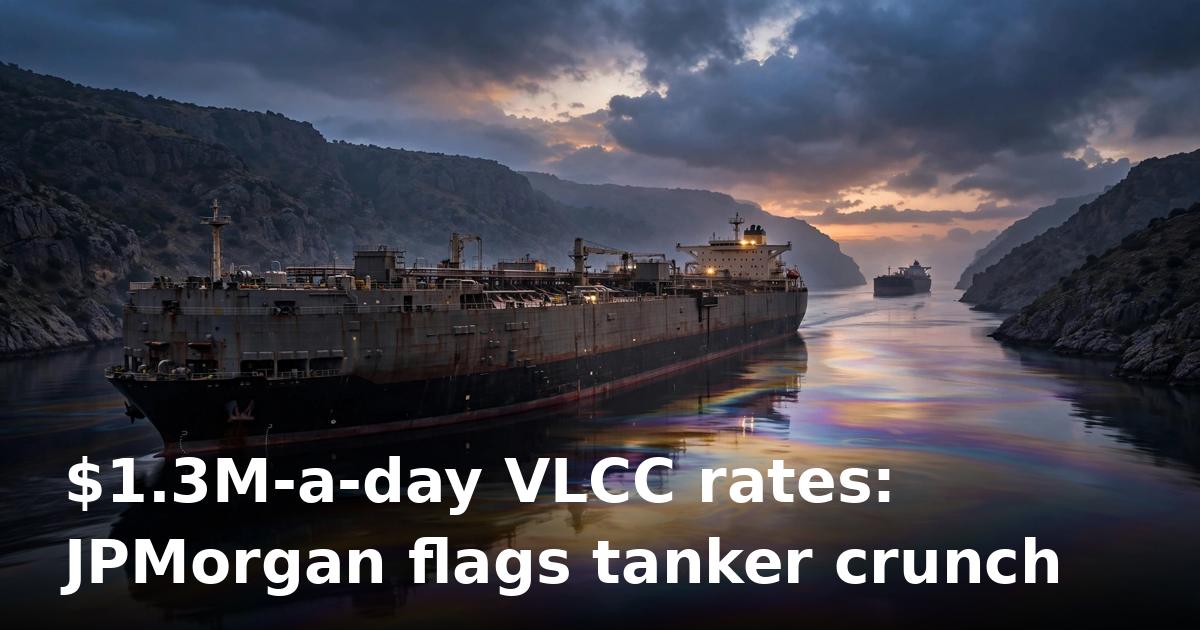

The price of crude on a delivered basis has returned to its spring peaks, JPMorgan's commodities desk said in an October 9 research note — but this time the bottleneck is not a lack of barrels. The note's authors — Natasha Kaneva with Lyuba Savinova and Artem Fakhretdinov — argue the October squeeze stems from how expensive and difficult it has become to transport oil, rather than from a shortfall of crude itself, a sharp reversal from the April stress when physical shortage was the problem. Flows through the Strait of Hormuz jumped from roughly 7.5 million barrels a day through July and August to near 12 million a day in September, dragging most of the world's tanker fleet into the region. In September, 766 vessels were in active service out of a 923-strong global VLCC fleet — more than four in five — leaving almost no spare capacity. European refining margins have slid back below zero in parallel, raising the risk that refiners cut runs.
April's stress is back, with ships rather than crude as the missing piece.
The strain is not only about how many hulls exist but how little each one can move. Cargoes now sit through ship-to-ship transfers at sea for up to 10 days, and vessels are taking longer routes to avoid higher-risk waters — both stretch voyage lengths and cut the number of deliveries each tanker can complete. Sanctions tighten the picture further: about 125 Iranian VLCCs, close to 13% of the global fleet, remain effectively shut out of the mainstream market. The fleet working Middle Eastern barrels outside Iran now runs roughly 35 extra VLCCs; add 13 Suezmaxes and 10 Aframaxes against the 2025 average, by the bank's math. The rest of the world is compensating by pushing cargoes onto smaller vessels: Aframax employment outside the Middle East has risen by about 140 ships, or 23%, Suezmax use is up around 50 vessels, or 11%, while VLCC employment elsewhere has dropped by 16 ships as the Middle East absorbs the big fleet. The bank's conclusion is uncomfortable — pumping more crude would not ease the strain, because extra exports without extra ships could deepen it.
Why it matters
The split between benchmark futures and what refiners actually pay is where this story bites. Negative European margins mean run cuts are a real possibility, and run cuts would trim crude demand — which could hold benchmark prices down while delivered costs keep rising. That is an unusual shape: a market where futures look tame while the physical barrel delivered to a refinery gate keeps getting dearer. Anyone positioned in crude through futures needs to understand the wedge. We covered the freight side of this strain two days ago, when VLCC charters hit $80 million for the US Gulf-China run, and the war-premium angle when Brent held near $104 on tanker-attack risk. This JPMorgan note is the structural piece underneath both: a fleet that cannot grow fast enough for the volumes being asked of it.
| Tanker fleet pressure | Figure |
|---|---|
| VLCCs in service (Sept) | 766 of 923 (83%) |
| Iranian VLCCs shut out | ~125 (13% of fleet) |
| Extra ships needed vs 2025 avg | +35 VLCCs, +13 Suezmax, +10 Aframax |
| Aframax employment ex-Middle East | +140 vessels (+23%) |
| Record VLCC day rate | ~$1.3 million |
What to watch
- The pace of Hormuz flows through October — 12 million barrels a day is already absorbing the fleet, and any increase would widen the vessel deficit.
- Day rates for smaller tanker classes, which are absorbing the overflow as VLCC capacity stays pinned.
- Any shift in US pressure on Iranian shipping, since 125 VLCCs returning to the mainstream market would change the arithmetic fast.
- European refinery run data in the coming weeks — sustained negative margins are the trigger for the demand-side counterweight.
MarketRadar take
Bullish for delivered crude and for tanker rates — the fleet math leaves little slack before year-end, and the $1.3-million-a-day VLCC rate is a record, not an anomaly. Bearish for refinery margins, where run cuts are now the release valve. Benchmark futures look neutral-to-soft while the physical-delivered spread stays wide: the market is pricing the ship, not the barrel, and that wedge is unlikely to close until vessels come back or flows slow down.