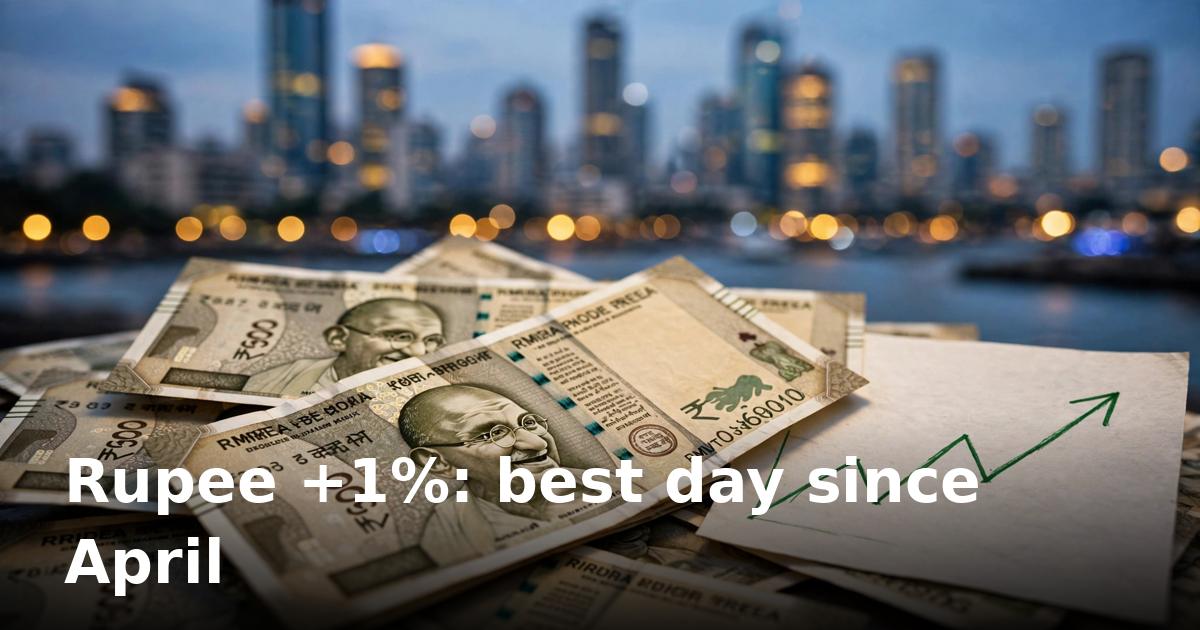

The Indian rupee just printed its best trading day since April. The currency firmed roughly 1% on Monday to around 95.77 against the dollar, a sharp reversal from Friday's 96.73 close and a strong rebuke to the slide that had taken it within touching distance of May's record low of 96.96. The move landed 48 hours after the central bank unveiled a weekend package to drain greenback demand from the system — and after traders spotted what looked like direct dollar sales by state-run lenders during the session. While most Asian currencies marked time in narrow ranges, the rupee was the session's clear outperformer. The currency is still down about 6.6% for the year.
The mechanics are what matter. Starting Monday, India's three state-run oil marketers began sourcing their dollars through a dedicated RBI facility rather than the open market — removing roughly $10-12 billion a month of greenback demand that would otherwise hit the exchange. The central bank also sharply raised the price of betting against the rupee: a new 20% cash requirement on certain FX derivative contracts left banks reluctant to quote forward dollar cover to importers, which should cool the hedging surge that had been feeding on itself.
Why it matters
India imports roughly 85% of the crude it burns, and with oil elevated — WTI traded near $92.60 on MarketRadar's latest snapshot — the import bill has been crushing the country's external account. That pressure created a self-reinforcing loop: expectations of further rupee weakness pushed importers to record levels of forward-dollar buying last month, and that hedging demand itself dragged the currency lower, which invited more hedging. The RBI's package attacks both ends of that loop at once — the structural demand from oil companies and the speculative bid in derivatives. It is also spending money to hold the line: FX reserves stood at $734 billion in the October 2 data, down from September's record $785 billion, while foreign investors have pulled more than $30 billion from local stocks this year. And the central bank is tightening with both hands — it also raised interest rates last Wednesday, the first hike in four years. The side effects are already visible in bonds: the benchmark 10-year yield jumped five basis points to 7.35%, its highest since November 2023, as traders priced in the fallout from the weekend measures.
What to watch
- Wednesday's US consumer inflation data, the next global catalyst traders are watching — a hot print could firm the dollar and test the rally.
- Forward premiums and NDF flows — Monday's gains themselves attracted offshore hedging flows into the NDF market, apparently tied to foreign investors' hedges on their India portfolios; watch whether the new rules keep that bid contained.
- FX reserve and hedging data in the coming weeks — analysts say they will reassess their medium-term views once the numbers land.
- Crude prices — the recent pullback in oil is supportive, but Brent keeps flirting with the $105 zone; a renewed spike re-prices India's import bill fast.
- The 96.50 line — analysts see the RBI turning vigilant again near that level; traders see room toward 95.50-95.00 if the rally extends.
MarketRadar take
Near-term, this is as supportive as a central-bank package gets: visible demand is gone from the exchange, depreciation trades cost more to hold, and the 1% Monday print broke the momentum of the slide. But nothing in the package fixes the two drivers — expensive oil and capital outflows — and reserves have already absorbed a steep drawdown. The risk-reward map below is how to read it.
The intervention package at a glance
| Measure | What it does | Market impact |
|---|---|---|
| Special dollar window for oil companies | RBI supplies dollars directly to IOC, BPCL, HPCL | ~$10-12B/month removed from spot bid |
| Rebooking of cancelled rupee derivatives banned | Closes a speculative workaround | Raises cost of depreciation bets |
| 20% cash vs certain FX contracts | Margin on deals above $2M (current account) | Banks pull back on forward hedges |
| No-proof exposure limit $100M → $5M | Fewer trades without underlying exposure | Less pure speculation |
Key levels in play
| Level | Value | Meaning |
|---|---|---|
| May record low | 96.96 | Line the RBI was defending |
| Friday close | 96.73 | Rupee fell 0.4% last week |
| Monday open / close | 95.76 / ~95.77 | ~1% relief rally on weekend measures |
| Trader extension zone | 95.50–95.00 | Where gains could reach if momentum holds |
| Analyst working range | 94.00–97.00 | Kotak Neo's framework; vigilance near 96.50 |
| 10Y yield | 7.35% | Highest since Nov 2023 |
Scenarios from here
| Scenario | Trigger | USD/INR zone |
|---|---|---|
| Rally extends | Crude keeps retreating, FPI outflows slow | 95.50–95.00 |
| Base: consolidation | Initial impact holds, data watched | 95.50–96.50 |
| ANZ fade case | BoP stress persists, hedging bid returns | Back toward 96.50+ |