
SpaceX finished Monday at $171.09, nearly 8% higher on the day and at its best level since June, after Morgan Stanley spent the weekend doubling down on its bullish call. Adam Jonas repeated the firm's Overweight recommendation alongside a $300 target in a note titled "SPCX $159: Cheap and Getting Cheaper" — roughly 89% above the $158.96 close from Friday. The timing fit the news flow: Musk had just confirmed on X that talks with Taiwan's TSMC about the Texas Terafab chip venture are still on. Investors also have a near-term catalyst circled: the Starship Flight 15 test, penciled in for late October or November, which Jonas described as the biggest potential positive catalyst since the stock's record June IPO. The advance was enough to lift Musk's estimated fortune back above $1 trillion for the first time since the summer.
Forbes put Musk at $1.046 trillion after Monday's session — a roughly $30.6 billion jump from Friday — with Jeff Bezos a distant second at $371.5 billion. Musk owns about 38% of SpaceX including options, plus nearly 11% of Tesla. Almost all of his wealth rides on two tickers.
That concentration cuts both ways.
Jonas's case is a valuation argument, not a launch-count argument. His sum-of-the-parts math says today's price mostly pays for rockets and Starlink — about $127 a share — while the AI business gets credit for only about $32. The AI piece is where he sees the mispricing: SpaceX's recent computing deals were struck at $30 to $50 per watt of capacity, while analyst models assume $17.60. The company reportedly has about $3.28 billion a month in compute deals with Anthropic, Alphabet and an undisclosed customer once fully operational. On a growth-adjusted basis, Morgan Stanley puts SpaceX at about 0.3 times EV/EBIT-to-growth versus a 0.5 times peer median — roughly 40% cheaper than the mega-cap AI crowd it keeps being compared with.
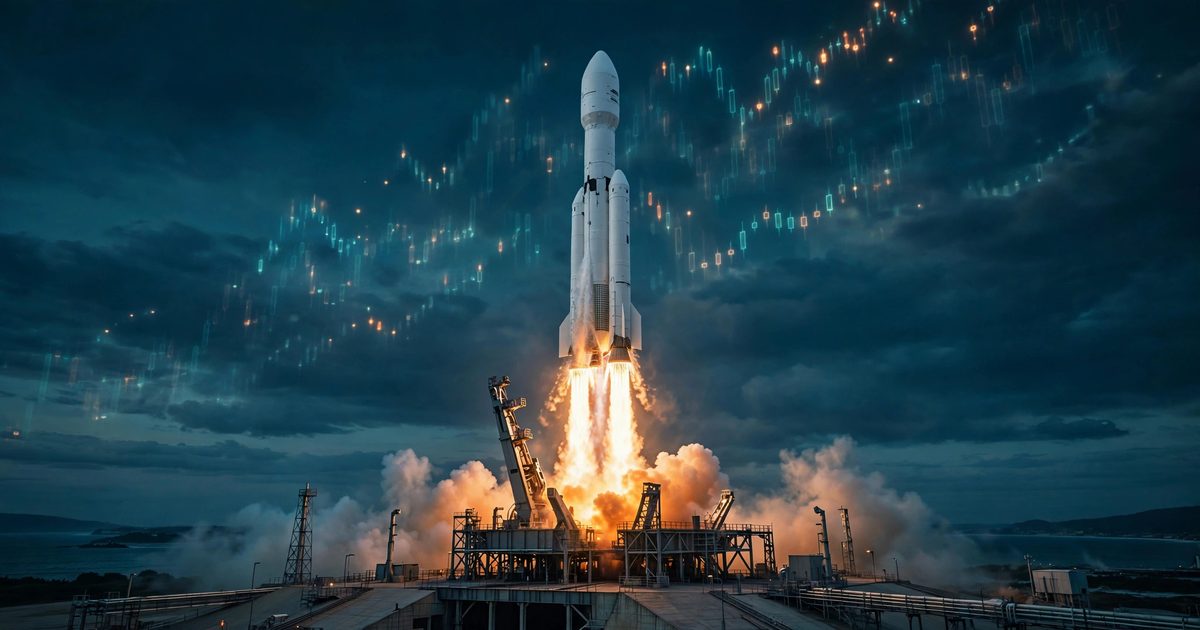
Starship is the near-term trigger. Flight 14 reached low Earth orbit for the first time and deployed 26 Starlink V3 satellites; Flight 15 could attempt a mid-air "ship catch" of the upper stage, a step toward a fully reusable system that would slash launch costs. Wells Fargo expects two to three more launches before year-end.
Then there is the chip angle. Musk confirmed the TSMC talks on October 3 with a terse X post: "Just discussions, but something may come of it." The project is Terafab, the joint Tesla-SpaceX-xAI chip venture in Grimes County, Texas, with a $16.8 billion phase-one commitment and filings pointing to as much as $119 billion over all phases. The goal is a vertically integrated fab complex targeting about one terawatt of annual AI compute capacity — aimed at Optimus robots, Cybercab vehicles and SpaceX's planned orbital data centers. Intel, which signed on as the first manufacturing partner in April, fell more than 4% in premarket trading on the news while TSMC rose about 3% in Taiwan. Musk later added that any TSMC chips would likely be supplemental to Intel as the primary provider.
Why it matters
The rally says the AI trade still has buyers even with the 10-year Treasury at 5.34% and the Fed firmly in a hawkish stance. Our market snapshot has the S&P 500 at 7,774, up 0.66% on Monday, and the Nasdaq at 27,477, up 1.05% — tech led the day, and SpaceX led tech. At roughly $2.16 trillion in market value, SpaceX now moves like a mega-cap index heavyweight without being in any index, which is why the S&P 500 setup after the soft NFP and the broader equity-bond standoff at 24-year-high yields matter for SPCX holders: the stock is priced for growth while government bonds pay investors handsomely to wait. The deeper story is the AI repricing. Morgan Stanley's math implies the AI slice of SpaceX would need to expand from $32 to $173 a share for the $300 target to land — a more than fivefold expansion that depends on compute contracts scaling and the Terafab supply chain actually getting built. See our stocks coverage for more on the equity rotation.
What to watch
- Starship Flight 15 in late October or November — watch for confirmation of a "ship catch" attempt of the upper stage.
- Third-quarter earnings later this month: the first real look at adoption of SpaceX's AI services, including Cursor and Grok Bot.
- TSMC/Terafab talks — whether they move past "just discussions," and what that means for Intel's role as primary supplier.
- SpaceX's orbital data-center push: the Star Mind satellites packing 250 kW of solar power for in-orbit computing.
| Morgan Stanley sum-of-the-parts | Implied at ~$159 | Implied at $300 target |
|---|---|---|
| Rockets + Starlink | $127/share | $126/share ($8 launch + $118 Starlink) |
| AI business (Grok + enterprise) | $32/share | $173/share ($8 + $165) |
| Total | $159 | ~$299 |
MarketRadar take
The setup into Flight 15 is straightforward: Jonas's call gives the stock a valuation anchor, and Starship provides the event. The two numbers that matter from here are the $30.71 gap to the June record — 15.2% — and whether compute-deal pricing near $30-$50 per watt holds as capacity scales. If the AI slice really does expand from $32 toward $173 a share, the $300 target stops looking aggressive. If compute pricing normalizes toward the $17.60 analysts assume, the stock is mostly a very good rocket company again. Either way, Starship Flight 15 is the date that settles the first leg of the argument.