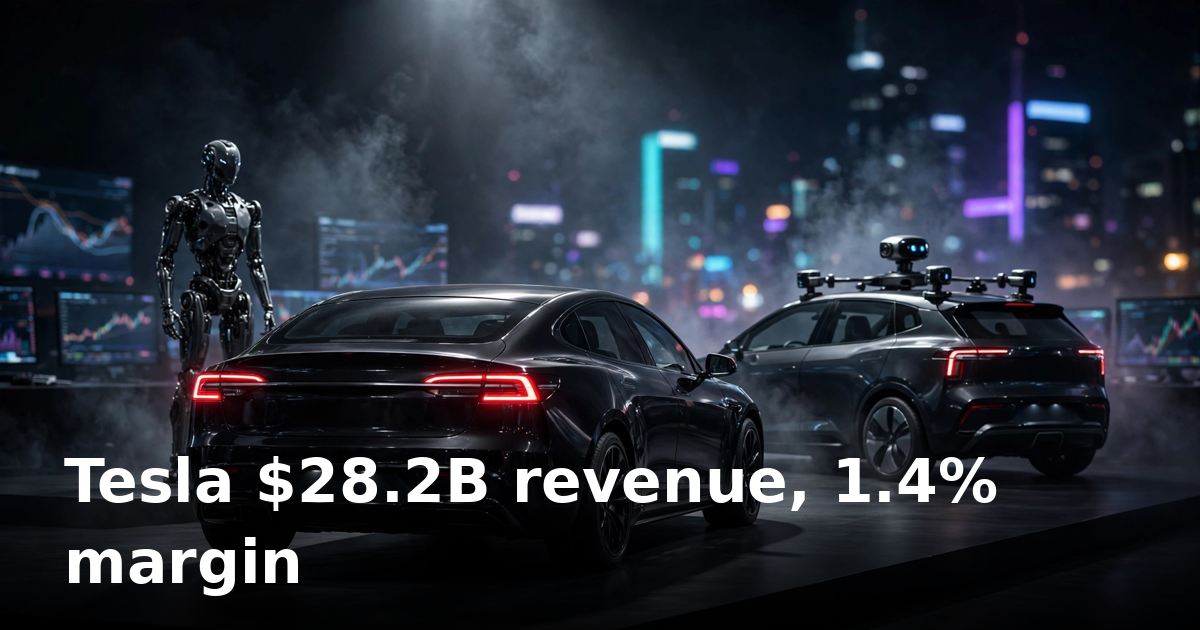

Tesla walks into its October 21 earnings call with a split personality. The car business just posted its strongest delivery quarter in a year — 486,532 vehicles in Q3, comfortably above the 461,974 consensus, a figure we covered when it beat every estimate. Revenue hit a record $28.2 billion in Q2, up 26% year over year. Those numbers would make this an autos story. The rest of the filing will not let it be one.
Because underneath the record revenue, the core business is earning less and less. Q2 operating income fell 57% to $398 million, crushing the roughly $1.5 billion analysts expected, and operating margin compressed to 1.4% from 4.1% a year earlier. Non-GAAP earnings came in at $0.33 a share, down 18% year over year and about 40% below consensus. The cause is visible on the cash flow statement: capital spending jumped 142% to $5.79 billion in the quarter, CFO Vaibhav Taneja has guided full-year 2026 capex above $25 billion, and free cash flow printed negative $1.09 billion. Operating cash flow itself was strong at $4.7 billion, up 85% — the money is coming in, then going straight out the door again.
That door leads to robots. Cybercab production has started at Gigafactory Texas, where installed capacity sits above 125,000 units a year. Six markets run the robotaxi with no one behind the wheel — Austin, Dallas and Houston in Texas, Miami, Orlando and Tampa in Florida — while the Bay Area service still carries a safety driver. In Fremont, Tesla pulled out the old Model S and X lines to make room for its first Optimus humanoid robot lines. None of this is cheap, and Tesla itself describes this as its largest investment period.
Record revenue, collapsing profit. That contradiction is the entire investment case heading into the October 21 print.
Why it matters
Tesla's weight in the Nasdaq 100 means its margin trajectory moves the index's technology sleeve. A company earning a 1.4% operating margin while investing like a late-stage startup is a different risk profile than the high-margin software business the multiple implies. For index watchers, the October 21 print is a sentiment check on the whole AI-capex trade: Tesla's $5.8-billion quarterly spend sits inside the same investor debate as hyperscaler capex budgets. One thread also deserves attention on its own terms — the software pivot is producing numbers. Active FSD subscriptions reached 1.48 million in Q2, up 56% year over year from 1.28 million in Q1, and more than 55% of new North American deliveries left the lot with an FSD subscription attached. Services and other revenue grew 50% in the quarter, the fastest of Tesla's three reporting lines, and energy storage hit 13.5 GWh in Q2 (+41% y/y) and 13.7 GWh in Q3. The moonshots have P&L lines now. They just aren't big enough yet to cover the car-margin erosion.
Tesla bulls get the delivery math on their side. Nine-month deliveries stand at 1,324,681, up 8.8% year over year, and only about 311,500 more in Q4 would top 2025's full-year 1.636 million — Tesla shipped 418,227 in last year's final quarter, so that bar looks reachable. Analysts have already moved the goalposts to 1.82 million for the full year, which would demand roughly 495,000 Q4 deliveries, a quarterly record by a wide margin. UBS raised its target to $391 from $385 on October 7, keeping a buy rating.
What to watch
- October 21, after market close: Q3 revenue, margins, free cash flow, and any update to the full-year capex pace — the four numbers that settle the "can the cars fund the robots" question for this quarter.
- Robotaxi expansion pace: new metro launches or unsupervised milestones; seven areas are live today.
- FSD subscription count for Q3: 1.48 million in Q2 with 56% year-over-year growth — a stall here would undercut the software-pivot narrative.
- Delivery run-rate vs the 1.82M bar: October delivery data in Europe and China will show whether a record Q4 is remotely in reach.
MarketRadar take
Neutral into the print. The auto recovery is real — deliveries beat, inventory is drawing down, and Q4 can plausibly top 2025's full-year total. But every dollar of that recovery is being absorbed by investment in businesses that contribute a sliver of current earnings. With cash and investments at $43.5 billion, there is no funding risk; the question is purely how many quarters of 1.4% margins investors will finance while waiting for robotaxi and Optimus revenue to scale. For the Nasdaq 100, a margin surprise in either direction on October 21 will travel beyond one stock — this is one of the index's bellwethers for the AI-capex narrative.