
Ace investor Mukul Agrawal has bought into one of the year's hottest Indian SME listings. Shareholding data shows he now holds 146,400 shares of Apsis Aerocom — a 1.21% stake worth roughly Rs 9.2 crore, per Financial Express — in a precision engineering company whose stock has surged 470% since its 18 March debut on the NSE SME platform. The Economic Times puts the position against a portfolio Trendlyne values near Rs 8,000 crore, and notes Agrawal simultaneously trimmed his holding in KRN Heat Exchanger and Refrigeration after that stock gained 45% in 2026 and 61% over the past year. His portfolio moves are among the most closely watched disclosures in Indian markets, routinely moving retail flows on publication. Both outlets stress the picture is provisional: full Q2 shareholding filings are not out yet, and the positions could still shift. This is the first time the Apsis holding has crossed the 1% visibility threshold.
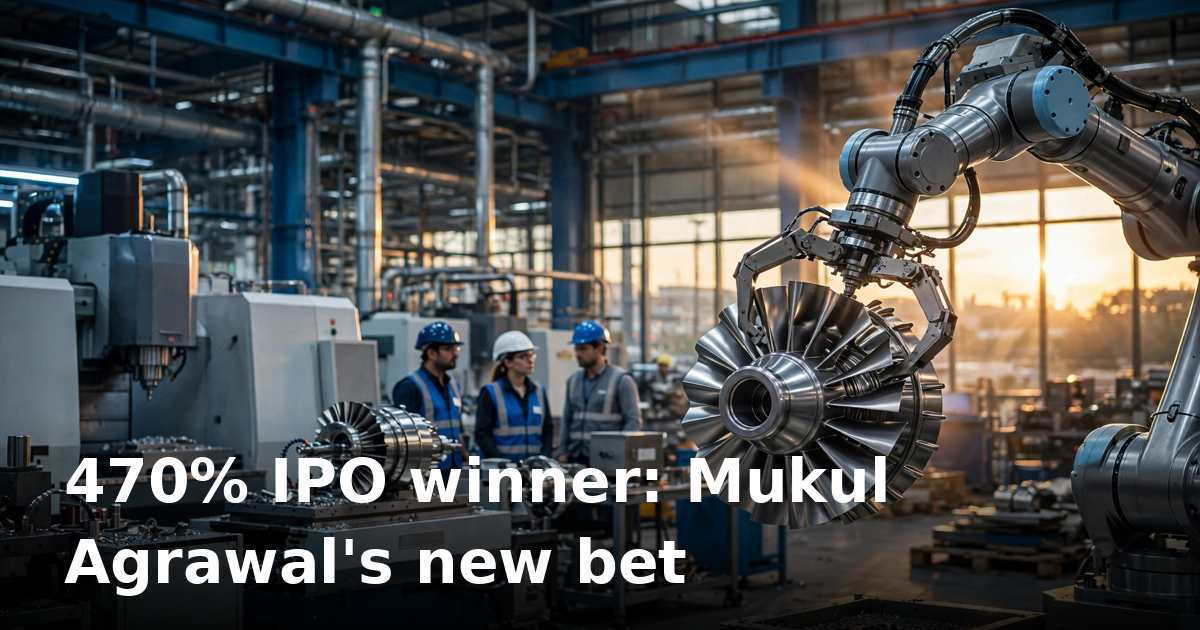
Apsis Aerocom is a Bengaluru precision engineering outfit serving aerospace, defence and healthcare buyers, running machining, surface finishing, assembly and quality control under one roof. Defence is the engine: it contributed about Rs 20 crore of FY26 revenue — roughly 65% of the Rs 30.7 crore total — with aerospace adding Rs 7.9 crore and healthcare Rs 2.4 crore, according to FE. The open order book stood at Rs 40.5 crore at last count, about 1.3 times FY26 sales, with Rs 25.3 crore of it defence work. The Rs 36 crore IPO was subscribed 129.33 times overall — retail took over 100 times, non-institutional investors about 237 times — priced in a Rs 104-110 band and listed at a 39% premium.
Here is the telling detail: the maths says he bought the rally, not the IPO. Rs 9.2 crore divided by 146,400 shares implies about Rs 628 a share — and a 470% gain on the Rs 110 issue price is Rs 627.
That reading matters because it changes the signal. This is not an early backer being revealed; it is a momentum-tilted entry into a Rs 755 crore market-cap stock trading at roughly 24.6 times FY26 sales. Names only surface in Indian filings above the 1% threshold, so this is the first public sighting — and both outlets caution the picture is provisional until Q2 shareholding disclosures are fully out. For scale, the Rs 9.2 crore stake is about 0.11% of an Rs 8,000 crore portfolio: a toe-hold, not a conviction-sized bet.
The business itself has grown fast off a small base. Sales climbed from Rs 10.4 crore in FY23 to Rs 30.7 crore in FY26, EBITDA margins reached 37.5% last year, and net profit hit Rs 7.5 crore — a three-year net profit CAGR of 95%, per FE. The shareholder base nearly doubled from 307 at listing to 521, while foreign institutions cut their holding from 3.02% to 0.39% over the same six months and domestic institutions reduced from 5.25% to 2.73%. Management has guided to about Rs 48 crore of revenue in FY27, which needs 56% growth this year, and speaks of Rs 500 crore by around 2031. That would require roughly 75% annual growth for five years. Treat the second number as ambition, not forecast.
| The entry, in numbers | |
|---|---|
| Shares bought | 146,400 (1.21%) |
| Implied entry price | ~Rs 628/share |
| 470% on Rs 110 issue price | Rs 627 |
| Stake value | ~Rs 9.2 crore |
| As share of Rs 8,000 cr portfolio | ~0.11% |
| Market cap vs FY26 sales | 24.6x (Rs 755 cr / Rs 30.7 cr) |
| Order book vs FY26 sales | 1.3x (Rs 40.5 cr / Rs 30.7 cr) |
Why it matters
Super-investor filings move money in India. When a name like Agrawal appears in a small-cap register, retail flows often follow the disclosure rather than the fundamentals — and in an SME stock with 521 shareholders and anchor lock-ins only expiring in April and June, that follower effect can be outsized relative to the Rs 9.2 crore that started it. The defence-aerospace manufacturing theme is also doing real work here: domestic precision engineering tied to offset obligations and Indian Air Force and Navy programmes is exactly the cohort drawing capital while foreign investors keep selling Indian equities and bond yields stay elevated.
The backdrop is noisy. The Economic Times frames the move against FII outflows, rising oil and climbing yields — the same forces that have kept the rupee under pressure this year. Yet Indian equities are holding up: the Sensex was trading up more than 400 points at 72,362.82 on Tuesday, per InvestingCube, while the Nifty held above 22,500, even as South Korea's Kospi slid 7.4% on chip-competition fears and AI spending warnings. Capital is rotating out of semiconductor hardware into services and domestic manufacturing stories, and a defence-heavy SME fits that rotation neatly. The silver market showed the same yield-driven repricing last week, which tells you how much of this year's price action is still about the bond market. The question for anyone reading the filing as a buy signal is whether the rotation justifies 24.6 times sales on a company that has to grow revenue 56% this year to meet its own guidance. If the order book converts, the multiple compresses fast; if it does not, the follower crowd learns why the entry was a toe-hold.
What to watch
- The full Q2 shareholding filings — both outlets flag the current picture as provisional, and the position could change as more disclosures land.
- Whether Apsis converts its Rs 40.5 crore order book into the guided Rs 48 crore FY27 revenue, the first real test of the growth story.
- Fresh defence order wins beyond the current book, since defence is 65% of revenue and Rs 25.3 crore of the backlog.
- KRN Heat Exchanger's next quarter — Agrawal trimmed a stock trading at 107 times earnings after a 61% one-year run, and institutional buyers (FII 8.37%, DII 8.64% in June) are picking up the other side.
MarketRadar take
Read the trade, not the name. Agrawal bought the winner after the sprint — paying full post-rally price — sized it at a tenth of a percent of his portfolio, and funded part of the rotation by trimming a 107-times-earnings winner. That is disciplined portfolio maintenance, not a signal to chase. The disclosure is neutral for the stock; the real variable is whether a Rs 755 crore company with a Rs 40.5 crore order book can grow into a 24.6x sales multiple. Watch the FY27 delivery, not the filing.