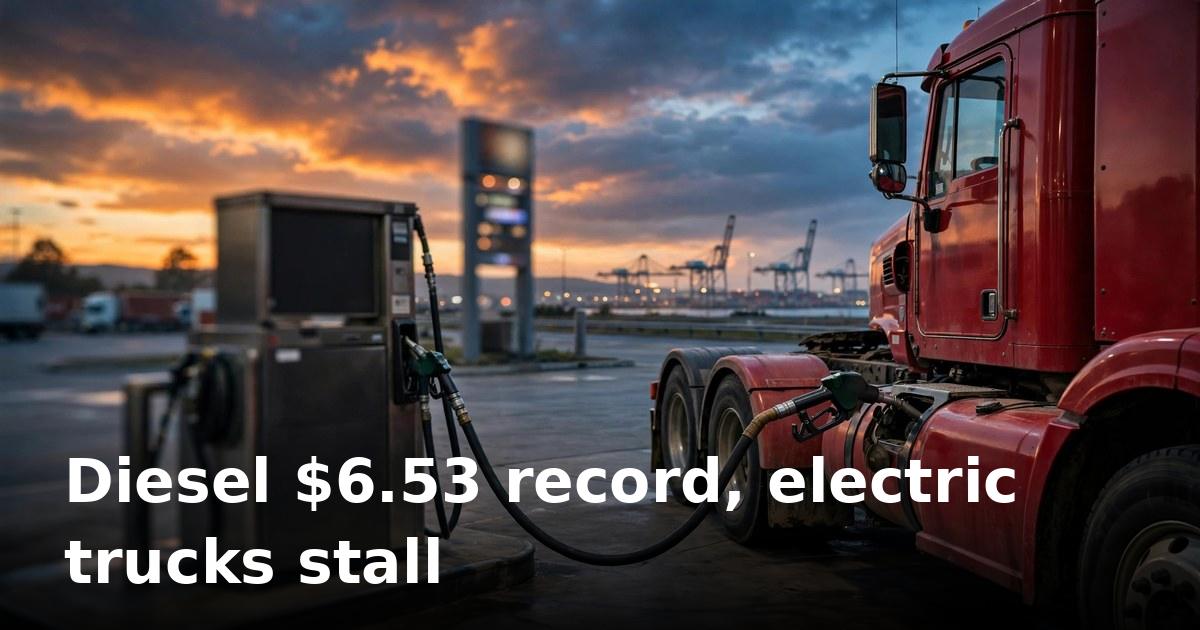

Diesel has never cost this much in America. The national average retail price hit a record $6.528 a gallon in September, according to energy pricing firm OPIS, and in California — where fuel runs dearest — it touched $8.439 on September 22. AAA data puts the state average at $8.35 a gallon as of Thursday, up from $5.16 a year earlier, a jump of roughly 62%. The surge is flowing straight into freight bills: trucks move nearly everything Americans buy, and fuel surcharges are climbing with the pump price. The US Energy Information Administration lifted its oil price outlook this week, pointing to shrinking global inventories and disruptions tied to the Iran conflict.
Here is the twist: even at these prices, battery-electric trucks still cannot make the math work.
At Los Angeles and Long Beach — the busiest container complex in the country — drivers running zero-emission rigs say they cannot compete with diesel rivals, and they have asked the ports for help with costs. A draft program would pay $60 each time a zero-emission rig handles a container move, with yearly payments topping out at $36,000 per truck across a three-year run; the two port boards are expected to vote in the coming months. Of the roughly 17,000 trucks serving the complex, under 700 run on zero emissions. Port of Los Angeles chief Gene Seroka acknowledged that subsidies alone may not be the full answer, but said the ports may need to act as a bridge.
Why it matters
Start with the sticker shock. Research from the International Council on Clean Transportation puts the typical 2024-model battery-electric heavy-duty tractor at about $379,800 — roughly two and a half times a comparable diesel rig, which implies a diesel tractor near $150,000 and an upfront premium of around $228,000. Beyond the purchase price, operators face steeper bills for charging gear, costlier financing and insurance, and lost time: a diesel refuels in minutes while electric rigs need specialized high-powered chargers and longer stops. Heavy batteries can also eat into payload under weight limits. The result is visible at the San Pedro Bay ports, where only about 3% of the drayage fleet is zero-emission and just 426 of the 667 qualifying trucks were active as of July. For energy markets, the message is blunt: trucking's diesel habit is not breaking anytime soon, which keeps a floor under refined-product demand even as crude itself swings on war headlines.
California's response shows how far policymakers will go to force the transition. Senate Bill 1213, signed by Governor Gavin Newsom on September 20, requires truck makers to disclose pricing details from 2027 so regulators can check whether public incentives actually lower costs for hauliers or simply pad manufacturer margins. Meanwhile US commercial crude stocks dropped 3.2 million barrels in the week ended October 2 to 424.1 million, EIA data cited by the Journal shows — the tight-stock backdrop behind the pump-price records.
What to watch
- Port board votes on the ZE-TRIP subsidy in the coming months; public comments on the draft close November 2.
- EIA's monthly outlook: diesel above $6 a gallon through October, easing toward about $4.50 in 2027 — any revision moves freight economics.
- Hurricane Isaias Gulf shutdowns and Houthi attacks on Saudi energy sites — both are squeezing refined-product supply right now.
- California's SB 1213 pricing disclosures from 2027, and whether truck makers cut electric-rig prices.
MarketRadar take
| Cost item | Figure | How we get it |
|---|---|---|
| Electric tractor, 2024 median | $379,800 | ICCT research |
| Diesel tractor, implied | ~$150,000 | $379,800 / 2.5 |
| Upfront price gap | ~$228,000 | difference |
| ZE-TRIP max per truck | $108,000 | $36,000 x 3 years |
| Gap left after max subsidy | ~$120,000 | $228,000 - $108,000 |
The arithmetic is the story. Even if a drayage operator maxes out the proposed subsidy — 600 terminal visits a year at $60 a visit to hit the $36,000 annual cap — three years of payments cover less than half of the electric truck's price premium over diesel. For diesel demand, this is structurally supportive: if the cheapest clean alternative still needs a six-figure subsidy per truck to compete at $8.44 diesel, freight will keep burning diesel for years. EIA's forecast carries an irony — if pump prices do slide back toward $4.50 in 2027, the fuel savings that are supposed to sell electric trucks shrink with them. Electrification's business case gets harder, not easier, when diesel gets cheap.
Our read: neutral-to-bullish for diesel and refining margins while inventories stay tight and the Iran-linked risk premium persists. The number that would change it is a sustained drop in retail diesel back under $5 — until then, the subsidy debate at the ports is a sideshow next to the fuel bill.